-
Title
-
Okładka i noty autorach / Polska Sztuka Ludowa-Konteksty 2011, t.65, z. 2-3
-
Description
-
Polska Sztuka Ludowa-Konteksty 2011, t.65, z. 2-3
-
Creator
-
Konteksty- redakcja
-
Date
-
2011
-
extracted text
-
noty.ps - 10/18/2011 6:36 PM
Noty o autorach
Giorgio Agamben – włoski filozof, jeden z czołowych
współczesnych intelektualistów europejskich. Autor
wielu książek, z których po polsku ukazały się: Profanacje (2006), Homo sacer. Suwerenna władza i nagie życie (2008), Co zostaje z Auschwitz (2008), Wspólnota,
która nadchodzi (2008), Stan wyjątkowy (2009), Czas,
który zostaje (2009), Nagość (2010).
Zbigniew Benedyktowicz – antropolog kultury, adiunkt w Instytucie Etnologii i Anropologii Kulturowej
UW, pracuje w Instytucie Sztuki PAN w Warszawie.
Redaktor naczelny kwartalnika „Konteksty”, członek
redakcji „Kwartalnika Filmowego”. Zajmuje się problematyką wyobraźni symbolicznej i antropologią kultury współczesnej. Autor licznych artykułów na ten
temat, współautor i redaktor naukowy książek: Film
i kontekst (1988); Sztuka na wysokości oczu. Film i antropologia (1991), Zbigniew Rybczyński – podróżnik do
krainy niemożliwości (1993), autor książek z zakresu
antropologii kultury: Dom w tradycji ludowej [z Danutą Benedyktowicz] (1992), Portrety „Obcego”. Od stereotypu do symbolu (2000), Dom – droga istnienia. Dom
w tradycji ludowej [w: 7 Triennale Sztuki Sacrum Dom –
droga istnienia. Miejska Galeria Sztuki w Częstochowie, Częstochowa 2009, The Home – the Way of Being.
The Home in Folk Tradition [z Danutą Benedyktowicz], Częstochowa 2009.
Ludwig Binswanger (1881–1966) – szwajcarski psychiatra, psychoanalityk. W psychoterapii stosował
niektóre zasady fenomenologii egzystencjalnej. Prowadził klinikę w Kreuzlingen. Napisał m. in.: Grundformen und Erkenntnis menschlichen Daseins (1962)
i Erinnerung an Sigmund Freud (1956) – wspomnienie
swej przyjaźni z Freudem.
Piotr Borowski – aktor i reżyser teatralny. Twórca
niezależnej warszawskiej sceny „Studium Teatralne”
na Lubelskiej 30/32 na warszawskiej Pradze. W działalność teatralną zaangażowany jest od 1975 roku,
kiedy związał się z teatrem „Laboratorium” Jerzego
Grotowskiego. Brał udział m. in. w przygotowaniach
i realizacji Uniwersytetu Poszukiwań Teatru Narodów
we Wrocławiu. W latach 1977-83 był aktorem i muzykiem w grupie teatralnej „Gardzienice” prowadzonej
przez Włodzimierza Staniewskiego. Po wyjeździe do
Włoch, w latach 1985-1993, Borowski pracował
w Ośrodku Jerzego Grotowskiego w Pontederze.
W 1995 roku prowadził warsztaty teatralne w CSW
w Warszawie. W 1996 roku założył niezależną grupę
teatralną Studium Teatralne, z którą zrealizował szereg przedstawień.
Benjamin Buchloh – historyk i teoretyk sztuki współczesnej, profesor na uniwersytecie Harvarda, redaktor
pisma „October”. Napisał: Neo-Avantgarde and Cultu-
ral Industry (2000), Art Since 1900 (współautor,
2004). Obecnie pracuje nad monografią Gerharda
Richtera (Gerhard Richter: Painting After the Subject of
History). Jest autorem wielu tekstów krytycznych m.
in. o międzywojennej awangardzie.
Giovanni Careri – historyk sztuki, wykładowca
w Ecole des Hautes Etudes en Sciences Sociales
(EHESS) w Paryżu i w Centre d’Histoire et Théorie
des Arts (CEHTA), profesor w Ecole des Beaux-Arts
w Lyonie. Napisał m. in.: Envols d’amour. Le Bernin
montage des arts et dévotion baroque (1990), La Jérusalem délivrée du Tasse. Poésie, peinture, musique, balet
(1999), Gestes d’amour et de guerre (2005).
Benedetta Cestelli Guidi – historyczka sztuki, wykładowczyni na uniwersytecie La Sapienza w Rzymie. Współpracowała z Instytutem Warburga przy
opracowywaniu fotografii z podróży Warburga do
Ameryki. Współredagowała Photographs at the Frontier: Aby Warburg in America 1895-1896 (Londyn
1998).
Jerzy Ćwiertnia (1928-2009) – malarz, grafik, filozof.
W latach 1947-53 studiował na Wydziale Malarstwa
warszawskiej ASP w pracowni Aleksandra Rafałowskiego. Uczestniczył w Ogólnopolskiej Wystawie Młodej Plastyki pod hasłem „przeciw wojnie – przeciw faszyzmowi” zorganizowanej w warszawskim Arsenale.
Był redaktorem graficznym i publicystą legendarnego
czasopisma „Po prostu”. Po jego zawieszeniu porzucił
malarstwo dla studiów nad filozofią i religiami Indii
i Dalekiego Wschodu oraz nauki sanskrytu. Do malarstwa powrócił ok. 1966. Wystawiał niezwykle rzadko.
Do najważniejszych wystaw, w których wziął udział,
należą: Świadectwa obecności (Kościół NMP w Warszawie); Współczesna Sztuka Sakralna z Polski (Eisenstadt, Austria); Biblia we współczesnym malarstwie polskim – przeżycia – inspiracje – ślady (Muzeum
Narodowe w Gdańsku); Formacja artystyczna Arsenał
55 (Muzeum w Gorzowie Wielkopolskim, 2005). Indywidualnie wystawiał w Galerii Historyków Sztuki
371
�noty.ps - 10/18/2011 6:36 PM
NOTY O AUTORACH
w Warszawie oraz w Zachęcie. Muzeum Okręgowe
w Sandomierzu na przestrzeni lat 1994-2008 wielokrotnie organizowało prezentacje jego twórczości malarskiej, po raz ostatni na wystawie jubileuszowej
w 2008 roku, z okazji 80-lecia urodzin artysty.
Małgorzata Dziewulska – eseistka, pisarz teatralny.
Wykłada na Wydziale Wiedzy o Teatrze Akademii
Teatralnej w Warszawie. Autorka licznych publikacji
o teatrze oraz książek m. in. Teatr zdradzonego przymierza, Artyści i pielgrzymi i Inna obecność.
Georges Didi-Huberman – filozof i historyk sztuki.
Wykładowca w Ecole des Hautes Etudes en Sciences
Sociales (EHESS) w Paryżu. Autor wielu książek dotyczących filozofii i antropologii obrazu, a także sztuki
współczesnej i renesansowej, m. in.: Invention de
l’hystérie (1982), Devant l’image. Questions posées aux
fins d’une histoire de l’art (1990), La Ressemblance informe, ou Le gai savoir visuel selon Georges Bataille (1995),
Devant le temps (2000). Po polsku ukazały się: Obrazy
mimo wszystko (2009) i Strategie obrazów. Oko historii
(2011). Jest autorem wielu tekstów reinterpretujących
spuściznę Warburga, w tym książki L’Image survivante
(2002).
David Freedberg – historyk sztuki, profesor na Uniwersytecie Columbia. Prowadzi badania nad ikonoklazmem i cenzurą, a także odbiorem dzieł sztuki. Znawca dawnej sztuki flamandzkiej i holenderskiej,
zajmował się również sztuką współczesną. Po polsku
ukazała się Potęga wizerunków. Studia z historii i teorii
oddziaływania (2005). Wydał m. in.: Dutch Landscape
Prints of the Seventeenth Century (1980), Rubens: The
Life of Christ after the Passion (1984), Iconoclasts and
Their Motives (1984), Art History, History in Art: Studies in Seventeenth-Century Dutch Culture (1992), The
Eye of the Lynx: Galileo, His Friends, and the Beginnings
of Modern Natural History (2002).
Jacek Dobrowolski – poeta, tłumacz, eseista i krytyk
urodzony pod znakiem Wierzby. Wydał tomiki poezji
Raróg i Partytury oraz komedię romantyczną Dziewanna. Publikował w: „Kulturze” (debiut u St. Grochowiaka), „Współczesności”, „Teatrze”, „Res Publice
Nowej”, „Odrze”, „Kontekstach”, „Rzeczpospolitej”,
„Gazecie Wyborczej”, „The Journalist’s Handbook”,
„The Irish Times”, „The European Quarterly”. Pionier tłumaczenia książek o medytacji zen. Autor scenariusza filmu Zaćmienie piątego słońca (TVP, 1991).
Od 1975 tłumacz mistrzów zen, naukowców (Vittorino Andreoli, Walter Burkert, Simon Goldhill, Richard Seaford, Richard Schechner, Oliver Taplin,
Martin West, Stephanie West, Andrzej Wierciński)
oraz artystów teatru (Eugenio Barba, Pina Bausch,
Grzegorz Bral, Peter Brook, Ariel Dorfman, Jon Fosse,
Peter Greenaway, Christopher Hampton, David Pountney, Peter Schumann, Włodzimierz Staniewski,
Ellen Stewart, Józef Szajna, Robert Wilson). Współpracownik BBC od 1989. Otrzymał brązowy medal
„Gloria Artis” w 2005.
Julián Gastelo – antropolog kultury, filmowiec–dokumentalista.
Marta Dziewańska – absolwentka wydziału filozofii
Uniwersytetu Paris I-Sorbonne. Pracowała w paryskim Centre Pompidou, od 2007 w Muzeum Sztuki
Nowoczesnej w Warszawie jako kurator badań i publikacji. Współredaktorka, z Claire Bishop, książki 19681989. Momenty zwrotne w polityce i sztuce (MSN,
2009), redaktorka Ion Grigorescu. W ciele ofiary
(MSN, 2010). Uczestniczyła w przygotowaniu wystaw: Niezgrabne przedmioty. Alina Szapocznikow i Maria Bartuszova, Pauline Boty, Louise Bourgeois, Eva Hesse, i Paulina Ołowska (MSN 2009) i Ion Grigorescu.
W ciele ofiary. 1969-2008 (MSN 2009). W 2011
współpracuje przy wystawie Alina Szapocznikow. Sculpture Undone (WIELS, Bruksela).
Ireneusz Guszpit – nauczyciel akademicki w Zakładzie Teorii Kultury i Sztuk Widowiskowych Instytutu
Filologii Polskiej Uniwersytetu Wrocławskiego, oraz
na Wydziale Aktorskim wrocławskiej PWST; miłośnik teatru i biegów maratońskich.
Jacek Jaźwierski – historyk sztuki, dr, adiunkt w Katedrze Teorii Sztuki i Historii Doktryn Artystycznych
Instytutu Historii Sztuki KUL. Zajmuje się badaniem
dziejów myśli o sztuce.
Wiesław Juszczak – historyk sztuki, filozof, profesor
Instytutu Historii Sztuki Uniwersytetu Warszawskiego
i Instytutu Sztuki PAN. Wybitny znawca malarstwa
polskiego XIX i XX w. Obecnie jego główne zainteresowania badawcze to filozofia sztuki oraz historia religii. Opublikował m. in. Wojtkiewicz i nowa sztuka
(1965); Jan Stanisławski (1972); Postimpresjoniści
(1973); Malarstwo polskie: modernizm (1977); Młody
Weiss (1979); Fakty i wyobraźnia (1979); Zasłona w rajskie ptaki albo „O granicach: okresu powieści” (1981);
Fragmenty. Szkice z teorii i filozofii sztuki (1995), przekładał m. in. Eliota, Blake’a, Karen Blixen. Ostatnio
wydał: Pani na żurawiach. Tom 1: Realność bogów
(2002), Malarstwo polskiego modernizmu (2005) i zbiór
tekstów Wędrówka do źródeł (2010). W 2010 roku został uhonorowany nagrodą polskiego PEN Klubu im.
Ksawerego i Mieczysława Pruszyńskich.
Ryszard Kasperowicz – dr hab., prof. KUL, kierownik
Katedry Teorii Sztuki i Historii Doktryn Artystycznych KUL. Opublikował m. in. Berenson i mistrzowie
Odrodzenia. Przyczynek do postawy estetycznej Bernarda
372
�noty.ps - 10/18/2011 6:36 PM
NOTY O AUTORACH
Berensona (Kraków 2000), Zweite, ideale Schöpfung.
Sztuka w myśleniu historycznym Jacoba Burckhardta (Lublin 2004). Przełożył i opatrzył wstępem tom esejów
Warburga Narodziny Wenus (Gdańsk 2010).
Ewa Klekot – antropolożka i tłumaczka, adiunkt w Instytucie Etnologii i Antropologii Kulturowej UW. Zajmuje się antropologią sztuki, a zwłaszcza zagadnieniami różnicującego potencjału sztuki w społeczeństwie
nowoczesnym oraz materialnością rzeczy uznawanych
za sztukę. Autorka licznych tłumaczeń książek i tekstów z zakresu antropologii i historii kultury.
Joseph Leo Koerner – profesor na Wydziale Historii
Sztuki i Architektury Uniwersytetu Harvarda, członek American Academy of Arts and Sciences oraz
American Philosophical Society. Wybitny znawca
sztuki niemieckiego renesansu. Opublikował m. in.
Dürer’s Hands, New York 2006; The Reformation of the
Image, London-Chicago 2004; The Moment of Self-Portraiture in German Renaissance Art, Chicago 1993;
Paul Klee. Legends of the Sign, New York 1991; Caspar
David Friedrich and the Subject of Landscape, New Haven-London 1990. Publikował w „Kontekstach”
w numerze 1/2010.
Magdalena Kraszewska – absolwentka ASP w Warszawie na wydziale malarstwa w pracowni prof. Artura Nachta Samborskiego i jednocześnie w pracowni
tkaniny artystycznej prof. Aliny Śledziewskiej. Obecnie zajmuje się rysunkiem i malarstwem akwarelowym. Jej prace znajdują się w rękach prywatnych oraz
w zbiorach Biblioteki Narodowej i Muzeum Tatrzańskiego. Od 1993 roku prowadzi Galerię Sztuki Współczesnej w domu rodzinnym w Zakopanem, gdzie odbywają się wystawy indywidualne i zbiorowe, koncerty,
promocje książek, zebrania stowarzyszeń i wieczory
poezji.
Andrzej Leśniak – historyk sztuki, absolwent Szkoły
Nauk Społecznych PAN. Adiunkt w Katedrze Kultury Współczesnej UJ. Pracował w Muzeum Sztuki
w Łodzi, wykładał w Instytucie Historii Sztuki i w Instytucie Kultury Polskiej Uniwersytetu Warszawskiego; przygotował cykl wykładów o teoriach nowoczesności dla Muzeum Sztuki Nowoczesnej w Warszawie.
Jest autorem książki Obraz płynny. Georges Didi-Huberman i dyskurs historii sztuki (Kraków 2010).
Krzysztof Lipka – muzykolog, historyk sztuki, eseista,
autor książek: Wariacje z fletem, Usta i kamień, Elegie
moszczenickie, Wszystko przez Schuberta.
Iwona Luba – dr historii sztuki, kierownik Zakładu
Historii Sztuki i Kultury Nowoczesnej UW, adiunkt
w Akademii Sztuk Pięknych w Warszawie.
Goshka Macuga – artystka. Urodzona w Polsce, studiowała w Central Saint Martins School of Art
i w Goldsmiths College w Londynie. W 2008 roku
znalazła się w gronie czterech nominowanych do prestiżowej Turner Prize, przyznawanej najwybitniejszym
młodym brytyjskim artystom. Mieszka i pracuje
w Londynie. Jej metoda pracy wykracza poza tradycyjnie pojmowaną rolę artysty: „Jestem artystką, która
próbuje rozszerzyć swoje działania o bycie kuratorem,
historykiem, opowiadaczem historii, krytykiem, archiwistą, projektantem wystaw, architektem, kompozytorem, galerzystą, socjologiem, biologiem, filmowcem,
kolekcjonerem, fotografem, performerem, magikiem
itd. ” mówi o sobie. W ostatnich realizacjach Macuga
w bardziej jednoznaczny sposób odnosi się do sfery polityki. Jej wystawa I Am Become Death w Bazylei
w 2009 roku obracała się wokół problemu neokolonialnej polityki Stanów Zjednoczonych. Artystka zestawiła m. in. zdjęcia Indian Hopi autorstwa Warburga i archiwum zdjęć amerykańskiego weterana wojny
w Wietnamie. Dominantę instalacji stanowiły rekonstrukcje rzeźb Roberta Morrisa z jego wystawy w Tate
Gallery w 1971 roku. Miała wystawy indywidualne m.
in. w Tate Britain (Londyn, 2007), Kunsthalle Basel
(Bazylea, 2009), Whitechapel Gallery (Londyn, 200910); brała udział w Biennale Sztuki w Wenecji (2009).
Chantal Marazia – dr filozofii, przygotowała rozprawę
doktorską o Ludwigu Binswangerze. Wraz z Davide Stimillim przygotowała do druku materiały dotyczące historii klinicznej Warburga i jego pobytu w Kreuzlingen.
Katia Mazzucco – w 2006 roku obroniła doktorat dotyczący projektu Mnemosyne Aby’ego Warburga.
Obecnie pracuje jako wykładowca na uniwersytetach
Ca’ Foscari i IUAV w Wenecji. Była współkuratorem
wystawy Atlasu Mnemosyne w Wenecji (2004). Jest
autorem tekstów w książkach i pismach m. in.: Introduzione ad Aby Warburg e all’Atlante della Memoria
(wraz z Kurtem W. Forsterem, 2002); Prefazione, [w]:
Ernst H. Gombrich, Aby Warburg. Una biografia intellettuale (2003); Coordinate di metodo. Un esempio: Aby
Warburg (2005); Uwagi do tekstów, [w]: Aby Warburg, Narodziny Wenus (2010).
Philippe-Alain Michaud – historyk i teoretyk sztuki,
kurator działu filmu w Centre Pompidou w Paryżu.
Bada pogranicza historii sztuki, antropologii i kina.
Jest autorem książek: Aby Warburg et l’image en mouvement (1998, wyd. ang. 2004) i Sketches. Histoire de
l’art, cinema (2006). Był kuratorem i współ-kuratorem
wielu wystaw w Centre Pompidou m. in.: Image en mouvement (2006) i La subversion des images (2009).
Monika Milewska – antropolog historii, eseistka, poetka, dramaturg. Adiunkt w Zakładzie Etnologii Wy-
373
�noty.ps - 10/18/2011 6:36 PM
NOTY O AUTORACH
działu Historycznego UG. Ukończyła z wyróżnieniem
Wydział Historyczny Uniwersytetu Warszawskiego,
gdzie doktoryzowała się w 2000 roku, Szkołę Nauk
Społecznych przy Instytucie Filozofii i Socjologii PAN
oraz Ecole des Hautes Etudes en Sciences Sociales
w Paryżu. Sekretarz Gdańskiego Oddziału Stowarzyszenia Pisarzy Polskich. Stypendystka m.in. Ministra
Kultury, Ministra Edukacji Narodowej, Rządu Francuskiego, Rządu Włoskiego. Autorka m.in. eseistycznej książki Ocet i łzy. Terror Wielkiej Rewolucji Francuskiej jako doświadczenie traumatyczne (słowo/obraz
terytoria, Gdańsk 2002), która przyniosła jej stypendium „Polityka” i nominację do Nagrody Literackiej
NIKE. Obecnie przygotowuje książkę o kulcie jednostki od Aleksandra Wielkiego do Kim Jong Ila.
Allgemeine Zeitung”, członek prezydium Goethe-Institut. Autor krytycznej niemieckiej edycji: Aby Warburg, Schlangenritual. Ein Reisebericht (Berlin 1988).
Paweł Mościcki – filozof, tłumacz. Doktorant w Instytucie Filozofii i Socjologii PAN. Laureat stypendium Fundacji Kościuszkowskiej w roku 2007/2008.
Zredagował książkę Maurice Blanchot – literatura ekstremalna (2006) i napisał dwie inne: Polityka teatru.
Eseje o sztuce angażującej (2007) oraz Godard. Pasaże
(2010). Przygotowuje doktorat o pojęciu potencjalności w pismach włoskiego filozofa Giorgio Agambena
oraz książkę poświęconą pojęciu utopii w historii politycznej i artystycznej ubiegłego stulecia.
Krzysztof Rutkowski – pisarz, eseista, tłumacz, dziennikarz. Historyk literatury romantycznej, profesor
Uniwersytetu Warszawskiego. W 1989 otrzymał Nagrodę im. Kościelskich. Tłumaczył m. in. książki Pascala Quignarda i Daniela Beauvois. Opublikował m.
in. Braterstwo albo śmierć. Zabijanie Mickiewicza w Kole Sprawy Bożej (1988), Stos dla Adama albo Kacerze
i kapłani (1994), Paryskie pasaże. Opowieść o tajemnych
przejściach (1995), Mistrz. Widowisko (1996), Raptularz końca wieku (1997), Książę bezdomny (1999), Kościół św. Rocha. Przepowieści (2001), Zakochany Stendhal. Dziennik wyprawy po imię (2005), Ostatni pasaż.
Przypowieść o byciu byle-jakim (2007), Requiem dla moich ulic (2008), Wokulski w Paryżu (2010).
Emilia Olechnowicz – w Instytucie Sztuki PAN przygotowuje doktorat o angielskich widowiskach dworskich.
Pracuje w Instytucie Dokumentacji i Studiów nad Literaturą Polską. Autorka książki Promieniowanie. Strony ze
szkicowników Zbigniewa Herberta (2009), redaktorka
albumu Józef Czapski. Wybrane strony (2010).
Katarzyna Prot – psychiatra i psychoterapeutka. Kieruje Centrum Zdrowia Psychicznego w Instytucie Psychiatrii i Neurologii w Warszawie. Specjalne obszary
zainteresowań to psychiatria środowiskowa i psychologiczne konsekwencje wydarzeń traumatycznych.
Jest autorką wielu artykułów fachowych, monografii
Życie po Zagładzie oraz współautorką książki Psychiatria
Środowiskowa jako środowiskowa opieka nad zdrowiem
psychicznym.
Renata Rogozińska – historyczka sztuki, etnograf,
profesor ASP w Poznaniu. Zainteresowania badawcze
koncentruje na problematyce współczesnej sztuki religijnej i sakralnej. Opublikowała wiele artykułów w katalogach wystaw, książkach oraz czasopismach, takich
jak „Konteksty”, „W drodze”, „Przegląd Powszechny”,
„Kresy”, „Czas kultury”, „Gazeta malarzy i poetów”,
Rzeźba Polska”, „Format”. Jest autorem książek
W stronę Golgoty. Inspiracje pasyjne w sztuce polskiej
w latach 1970-1999 (2002) i Ikona w sztuce XX wieku
(2009).
Małgorzata Sobieraj – historyk sztuki. Pracowała najpierw w Zakładzie Sztuki Nowoczesnej na UJ, a następnie (do dziś) w Instytucie Sztuki PAN. Pracowała
również w redakcji „Biuletynu Historii Sztuki”. Doktorat otrzymała na podstawie dysertacji o związkach
sztuki z polityką w dwudziestoleciu międzywojennym.
Zajmuje się m. in. twórczością Artura Grottgera i Jacka Malczewskiego.
Matthew Rampley – badacz sztuki XIX i XX wieku, zajmuje się zagadnieniami kultury wizualnej. Wykładowca
wydziału historii sztuki na Uniwersytecie w Birmingham. Wydał m. in.: Nietzsche, Aesthetics and Modernity
(2000), In Remembrance of Things Past: Aby M. Warburg
and Walter Benjamin (2000). Jest redaktorem prac zbiorowych Exploring Visual Culture (2005) i Art History and
Visual Studies in Europe. A Critical Guide (w druku).
Joanna Sosnowska – dr hab. historyk sztuki, docent
w Instytucie Sztuki PAN w Warszawie. Ukończyła
studia na Uniwersytecie Warszawskim, doktoryzowała
się w Instytucie Sztuki PAN, tam też uzyskała habilitację w 2004 roku. Wykłada na ASP w Warszawie.
Zajmuje się polską sztuką XIX i XX wieku. Wydała
Materiały do dziejów Instytutu Propagandy Sztuki
(1930–39), Polacy na Biennale Sztuki w Wenecji
1895–99 oraz Poza kanonem. Sztuka polskich artystek
1880–39. Publikowała m. in. w„Biuletynie Historii
Sztuki”, „Twórczości”, „Kresach”, „Znaku”, „Architekturze”.
Ulrich Raulff – filozof, historyk i dziennikarz. Dyrektor Archiwum Literatury Niemieckiej w Marbach.
Wieloletni redaktor działu kulturalnego „Frankfurter
Davide Stimilli – profesor literatury niemieckiej. Wykładał na wielu uniwersytetach we Włoszech
i w USA. Jest autorem Fisionomia di Kafka (2001), The
374
�noty.ps - 10/18/2011 6:36 PM
NOTY O AUTORACH
Face of Immortality: Physiognomy and Criticism (2004),
a także redaktorem zbioru niepublikowanych tekstów
Warburga „Per Monstra ad Sphaeram” (2005) i materiałów dotyczących historii klinicznej Warburga i jego
pobytu w Kreuzlingen (wyd. włoskie, hiszpańskie,
francuskie, niemieckie).
Monika Szewczyk – krytyczka i kuratorka sztuki
współczesnej. Współpracuje m.in. z pismami „A Prior”
i „Afterall”, a także licznymi ośrodkami sztuki w Niemczech i Holandii. Jest szefem publikacji w Centrum
Sztuki Współczesnej Witte de With w Rotterdamie,
współpracowała też z Vancouver Art Gallery.
Przemysław Strożek – doktor nauk humanistycznych, pracownik Instytutu Sztuki PAN. Specjalizuje
się w historii i historiografii awangardy ze szczególnym
uwzględnieniem badań nad włoskim futuryzmem.
Członek European Network for Avant-garde and Modernist Studies oraz zaangażowany w sieć tworzenia
międzynarodowych studiów nad futuryzmem: współautor przygotowywanej publikacji International Yearbook of Futurist Studies. Vol. 1. (De Gruyter,
2011). Publikował też m. in. na łamach „Pamiętnika
Teatralnego”, „Przeglądu Humanistycznego”, „Biuletynu Historii Sztuki”.
Kuba Szpilka – etnolog (studia UJ), studia doktoranckie Instytut Sztuki PAN, pisze pracę doktorską
poświęconą etnologicznej interpretacji kultury masowej. Mieszka w Kościelisku.
Tomasz Szerszeń – antropolog kultury i fotograf. Redaktor „Kontekstów”. Absolwent MISH na UW, Studium Doktoranckiego w Instytucie Sztuki PAN i Fotografii w PWSFTViT w Łodzi. Był stypendystą:
Fundacji na Rzecz Nauki Polskiej (2010), Stypendium
Artystycznego m.st. Warszawy (2010), Ministerstwa
Kultury i Dziedzictwa Narodowego (2007), Stypendium Rządu Francuskiego (2006, 2008). Publikował
m.in. w „Literaturze na Świecie”, „Kontekstach”, „Tygodniku Powszechnym”, „Kwartalniku Filmowym”,
„Res Publice Nowej”, „Dwutygodniku” i w antologii
Przekleństwa wyobraźni (Kraków, 2010). W listopadzie
2010 w Galerii Wymiany w Łodzi odbyła się prezentacja jego projektu artystycznego Byłem pierwszym polskim surrealistą. Prace z lat 1929-39.
Summaries
Tomasz Szerszeń Aby Warburg, Our Neighbour
Georges Didi-Huberman called Warburg „our obsession”, a Dibbuk that continues to haunt us. The
years-long successive work on an enormous archive –
Warburg’s bequest – revealing not only an outline of
Andrzej Turowski – historyk sztuki współczesnej.
Profesor emerytowany Uniwersytetu Burgundzkiego
w Dijon (1990-2009), doktor honoris causa Akademii
im. Strzeminskiego w Łodzi (2004), dyrektor Centre
de Recherche Comparative sur les Avant-gardes
(1990-2000), współdyrektor Galerii Foksal w Warszawie (1970-1983). Jest autorem licznych artykułów,
rozpraw i książek m. in: Konstruktywizm polski (1981),
Wielka utopia awangardy (1990), W kręgu konstruktywizmu (1976), Exit-t-il un art de l’Europe de l’Est
(1986), Budowniczowie świata. Z dziejów radykalnego
modernizmu (2000), Awangardowe marginesy (1998),
L’art et le discours face à la revolution (red., 1998), Arts
et artistes autour de Zervos (red., 1998), Między sztuką
i komuną (red., 1998). Wydał też monografie Jerzego
Kujawskiego i Kazimierza Malewicza. Kurator wielu
wystaw, m. in.: L’Europa dei razionalisti, Milano/Como
1989; Europa, Europa, Bonn 1994; Fin des temps! L’histoire n’est plus, Toulon 2004; Svegliato e sogna, Wenecja 2009.
never completed projects and the scale of quests but
also the history of a mental illness and an amazing return to health, became entangled with interest in
Warburg’s legacy, growing since the 1980s; thus at
the end of the twentieth century, Warburg, little
known during his lifetime, became, an emblematic figures of the contemporary humanities. This unexpected revival, „life after life”, so well inserted into the
„phantomatic model” of history construed by him, testifies not only to the belated discovery of his opus.
From the present-day view the impossibility of delineating the boundaries of the Warburg project appears
to be particularly intriguing, and its open form means
that writing today about his work signifies accepting
that one day our hypotheses and interpretations will
be modified or undermined.
Andrzej Turowski History of Art in an Age of Madness
History of art, as formulated by Warburg, comprised
375
�noty.ps - 10/18/2011 6:36 PM
SUMMARIES
a critical reference to the beginnings of the discipline
where not only the name but also the object of research and the method defined their sense and limits.
Such critique was paradigmatic and questioned the
epistemological foundations and methodological discourses of the „scientific” history of art. Taking into
consideration this basic transformation we must become aware of the fact that due to Warburg the „first history of art” based on an Enlightenment model was replaced by a „second history of art”, which came into
being in the psychiatric clinic and on the excavation
site of memory. The first emerged under the sign of
the Sun, while the second turned towards the melancholy of Saturn. Its centre was the motif of the threat
looming over man and the experience of a permanent
crisis.
Krzysztof Rutkowski Warburg and the Snake
This literary-biographical-philosophical passage shows
Warburg as a borderline figure constantly crossing the
boundaries between „science”, „art” and „life”, torn
between Apollo and Dionysius, between pagan antiquity and modernity, between health and mental illness...
Aby Warburg Seismographies
Two fragments concerning Seismographs (Burckhardt,
Nietzsche, Warburg), sensitive to motions concealed
for the contemporaries and the transferences to
which culture has been subjected.
Aby Warburg Burckhardt and Nietzsche
A fragment from the Warburg dairies on two models
„clairvoyance” in German-language culture upon the
thershold of modernity.
Tomasz Szerszeń Demons of War according to
Warburg. Kriegskartothek
The reaction of Warburg to the horror and destruction
of the 1914-1918 period assumed the form of an attempt at creating „war iconography” (a large collection
of photographs, postcards and maps) and overcoming
with their assistance images of the „demons” of war: anti-Semitism and nationalism.
Richard Kasperowicz The Image in the Conception by
Aby Warburg
The concept of the „image” assumed a key rank in the
interpretations proposed by Aby Warburg. The latter
did not accept the universally applied description, silently approved in the second half of the nineteenth
century, which either referred to assorted formalistic
aesthetics that granted autonomy to the form of the
artwork, or situated the form in an abstractly constructed system of the development of historical
forms. Warburg conceived the image as the outcome
of a complex historical situation in which the artist’s intentions play a role just as essential as the needs of the patron or the certain mental inclinations of
a milieu and inherited traditions. Constructing the
image crosses the demands of aesthetics and is enrooted in a convoluted psychological process, indicating
the anthropological justification of the image as
man’s cultural-biological function. At the time this
stand did not have a counterpart in the „classical” history of art and owed much to studies into religion
and the myth, consistently aiming at an interpretation
of art as the history of man’s visual expression transcending the traditional rigid rules of aesthetics.
Aby Warburg Images from the Region of the Pueblo Indians of North America
A famous lecture given by Warburg in a mental
hospital in Kruzlingen and concerning his „initiation”
trip to America.
Katia Mazzucco Bilder, Reise, Schlangenritual...
Aby Warburg’s journey in late nineteenth century in
Arizona and New Mexico Pueblo villages, and the influence of this experience on his theory of symbolic
thought and his research methodology, are inextricably connected both with the clinical story of the scholar and the rhapsodic editorial success of his writings.
The lecture Aby Warburg gave in Kreuzlingen in
1923 on Hopi Indians rituals remains the best known
of Warburg writings and places his studies among the
earliest contributions to modern inter-disciplinary
Cultural Studies. Bibliographic notes collected in this
paper trace the main editions of the Kreuzlinen lecture and some of the most important critical works on
Warburg american trip, as a guideline for a correct
contextualization of the work.
Ewa Klekot Narratives on a certain voyage
Presumably, if Aby Warburg had not lectured on 21
April 1923 in Kreuzlingen on Images from the Pueblo
Territory in North America, the only writers interested in his trip in the South-West in 1895-1896 would have been his biographers. However, the fact
that Warburg, hospitalized in Kreuzlingen sanatorium, decided that the first lecture he was going to
deliver since his mental collapse in November 1918
would be based on his memories of the American
trip, put the powerful interpretative machine of modern humanities into motion. Since then different
narratives on his trip have appeared, based on different versions of his lecture (no one published during
his life and with his consent), his diary, letters and
photographs. However, the question why he had decided to delve in his American memories while preparing a lecture that was supposed to prove his mental stability remains open for speculations. One of
376
�noty.ps - 10/18/2011 6:36 PM
SUMMARIES
the reasons of this choice may have been Warburg’s entanglement in his German identity, that actually had been a direct cause of his collapse only
a month after the armistice of 1918.
Ulrich Raulff The Seven Skins of the Snake. Oraibi,
Kreuzlingen and Back: Stations on a Journey into Light
What was it that Warburg found so fascinating in the
figure of the snake, and what granted it incomparable
power – the power of semantic change? Apparently, it
is due to the possibility of changing its meaning that
the snake is capable of the very process of creating
a symbol. Hence it is not an unambiguously defined figure but precisely a symbol of ambivalence.
David Friedberg Warburg’s Mask. A Study in Idolatry
The presented text is an attempt at a critical analysis
of the American episode in Warburg’s life and associated literature, whose considerable part repeats the
same information and motifs; almost all publications
represent an uncritical approach. Warburg has been
rendered the object of idolatry as a pioneering example of combining the history of art and anthropology.
His example is an excellent lesson on the dangers lurking in the meeting point of the history of art and anthropology: it calls for a less hagiographic approach on
the part of the reader and more caution.
Benedetta Cestelli Guidi Aby Warburg and Franz Boas: Two Letters from the Warburg Archive. Correspondence between Franz Boas and Aby Warburg (19241925)
The correspondence between Aby Warburg and
Franz Boas casts interesting light on the dialogue involving the history of art and anthropology and conducted in the first decades of the twentieth century –
a crucial moment in the history of both disciplines.
The presented correspondence confirms the profundity and range of Warburg’s interest in cultural anthropology and his proclivity for obliterating the borderline between cultural anthropology and the history of
art as well as a readiness to transfer his library to the
USA.
Goshka Macuga, Julián Gastelo Snake Society
The outcome a journey taken in the footsteps of Warburg by the Polish-British artist is the film Snake Society, part of a larger project entitled I Am Become Death.
We present fragments of the film’s transcription,
which together with photographs comprise a photo-essay.
Monika Szewczyk Recorded Conversation with Goshka
Macuga
Ludwig Binswanger Letter to Sigismund Freud
Davide Stimilli Warburg’s Tincture
This text is a record of an „incomplete treatment” –
a cure applied at the hospital in Kreuzlingen – as well
as testimony of the extraordinary relation between
the psychiatrists (Ludwig Binswanger, Emil Kraepelin) and the patient (Warburg).
Chantal Marazia Ludwig Binswanger and the Ritual of
Healing
Aby Warburg spent three years being treated by the
famous psychiatrist Ludwig Binswanger. Historiography and philosophy perceive the Swiss psychiatrist as
the (co) founder of humanistic psychology, based on
listening, empathy, an encounter of the doctor and
patient, as well as „existential communication” between them. Meanwhile, the treated and ultimately
cured Warburg showed no signs of a return to health
that would also involve his physician. Quite possibly,
the reason for this state of things was the fact that
Binswanger had never truly engaged his ”I”...
Joseph Leo Koerner Lecture as Rite de Passage
The Warburg presentation still fascinates due to the
proximity between the author and the topic. In this
curious discourse European cultural identity is regained thanks to becoming close to the Other, envisaged as „madness” and „savagery”. Warburg actually
performs a transition ritual, in which the object of the
analysis turns into the observing subject. This autobiographical attitude assumes particular meaning in
the present-day state of research.
Aby Warburg Mnemosyne Atlas. Introduction
An introducion to Warburg’s The Mnemosyne Atlas.
Aby Warburg Manet’s ‘Déjeuner sur l’Herbe’...
The only completed commentary to The Mnemosyne
Atlas boards.
Katia Mazzucco Mnemosyne: Bilderdemonstration, Bilderreihen, Bilderatlas...
With the name Mnemosyne we can identify a great
project by Aby Warburg, which includes the collection and systematization of his library, devoted to the
mother of the Muses, his last unfinished book, the
Atlas, and also documents that testify a praxis of
Warburg research methodology, the exhibition. This
paper collects critical considerations on these issues
and proposes an inedited chronology of documentary
photographs exhibitions – Bilderreihen and Bilderdemonstrationen – by the Kulturwissenschaftliche Bibliothek Warburg and of the preparatory stages of the
Mnemosyne book.
Georges Didi-Huberman Mnemosyne Atlas as
a Montage
377
�noty.ps - 10/18/2011 6:36 PM
SUMMARIES
Mnemosyne is an avant-garde object since it dares to reconstruct a historicist album of recollections about the
„impact of antiquity”, replacing it with a wandering album of memories modelled on the unconscious, full of
diverse images, imbued with anachronic and ancient
elements and suffused with the blackness of a backdrop
in which life plays the part of an empty space, a missing
link, a gap in the memory. The original model of the
Mnemosyne Atlas should thus be sought in the very
structure of the objects appearing in it, which become
analytically „disassembled” and „assembled anew”.
Giorgio Agamben Aby Warburg and the Birth of the
Cinema
The research conducted by Warburg coincides with
the birth of the cinema. That which at first glance appears to be shared by the two phenomena is the question of a presentation of motion. Warburg’s interest
in the depiction of the body in motion was connected
with his obsession with something that could be described as the „life of images”. He was the first to become aware of the fact that images transmitted by historical memory are not immobile but lead a peculiar
life, which he called posthumous life and survival.
Philippe-Alain Michaud Crossing the Frontiers: Mnemosyne – between Art History and Cinema
The Mnemosyne Atlas stressed the intrusion of photography into the discourse of the history of art and the
assumption of a place traditionally reserved for the
text. The Atlas does not restrict itself to describing
the migration of images in the history of representation, but reproduces them. In other words, Mnemosyne is based on a cinematic way of thinking – it uses figures not to express meanings but to yield effects. It is
precisely in the cinema that we may encounter the
strongest links with the Warburg undertaking.
Andrzej Leśniak Introduction to a Political Analysis of
the Mnemosyne Atlas by Aby Warburg
The unnamed science proposed by Aby Warburg is an
intellectual project within whose range images are
treated as complex cultural phenomena. The Mnemosyne Atlas, its most radical fragment, is critically valuable not only vis a vis the limits of the history of art as
a discipline but also the hierarchy that defines visual
art. For this reason, there exists a need for a political
analysis of the Atlas that would take into consideration the significance of the „moment of the new
exchange” programmed by Warburg on the modern
scene of the visual.
Paweł Mościcki Seismography of a Breakthrough. Revolutionary Gestures as Pathosformeln
Apparently, not much brings modern revolutionary
tradition close to Warburg’s research. Do studies into
Nachleben der Antike not contradict the tradition of
revolutionary change? Is „unnamed science” doomed
to be „reactionary”, to constantly seek the return of
that which is primitive, or is it capable to tell about
the fate of the nameless in whose name revolutions
are, as a rule, carried out? The search for analogies between the formulas of pathos present in the history of
the culture of antiquity, the Renaissance or late modernity, on the one hand, and the depictions of the
revolution and its participants, on the other hand, is
not supposed to exclusively portray some sort of
a continuum within the range of the „tradition of the
oppressed” alone or to persuade us to accept its cultural enrootment. In a certain sense, this is a hermeneutic of the revolution as such. In the reanimated scenes
of lofty pathos and dramatic suffering there stirs yet
another utopian vision of historicism itself and that
which revolution wants to accomplish within it.
Matthew Rampley Archives of Memory: Walter Benjamin’s Arcades Project and Aby Warburg’s Mnemosyne
Atlas
The Warburg method of a montage of images reflects
his comprehension of culture as a space of memory, in
which visual symbols (and not only) fulfil the function
of a sui generis archive of contrasted reminiscences. In
this aspect, his work can be compared to Benjamin’s Passagenwerk, with Benjamin writing about the
dialectic of that which is visible while Warburg conceived the dialectic of perception rather literally: the
most economical way of examining the process of sublimation is an actual comparison of visual representations.
Benjamin Buchloh Gerhard Richter’s Atlas: The Anomic Archive
During the twentieth century, an age of fading belief
in empiricism and aspirations towards a comprehensible completeness of positivistic systems of knowledge,
the term „atlas” assumed a metaphorical significance.
The most prominent example of this anti-positivistic
tendency is the Mnemosyne Atlas – a monumental
project whose purpose is gathering identifiable forms
of collective memory. The several decades later Atlas
by Gerhard Richter appears to treat photography and
its assorted practices as one of the instruments with
whose assistance collective anomy, amnesia and denial are socially encoded.
Marta Dziewańska Exercise in Imagination. ”Atlas.
How to Carry the World on One’s Back?” by Georges Didi-Huberman at the Museo Reina Sofia in Madrid
Inspired by the Mnemosyne-Atlas method, the exhibition is an experiment composed of works belonging to
different orders (paintings, photographs, documentation sketches and notes) arranged upon the basis of
378
�noty.ps - 10/18/2011 6:36 PM
SUMMARIES
the principle of “affiliation by choice” (known from
Warburg and Goethe). The perilous show – fragmentary, selective, concentrated on the detail and not belonging to any synthesis – became a sui generis search
for that which may be described as a ”form of visual
knowledge”. Formally bold, it poses a challenge both
for the practice of holding exhibitions and the routine of art institutions, while for the recipients it is
a specific “exercise in imagination”.
Giovanni Careri Aby Warburg. Ritual, Pathosformeln
and the Intermediate Form
In the iconographic tradition of the West certain configurations of gestures return after a long periods of
concealment, albeit carrying already a new emotional
burden. Can this phenomenon be understood while
limiting ourselves to an analysis of the images alone,
or should we rather embark upon an analysis starting
with ritual activity, myths and tales that accompany
a depiction of those gestures? How are those relics to
be perceived within the perspective of the anthropology of the image without succumbing to generalities
of the „social context” at the cost of the complex formal specificity of the „work of art”? Such questions, situated along the crossing point of anthropology,
aesthetics and the history of art were posed at the academic onset of this discipline by one of its founders –
Aby Warburg.
Emilia Olechnowicz Nachleben der Antike. The Medici Intermezza from 1589
The 29 years-old Warburg wrote a text about the Medici intermezza from 1589, regarding them as intermediate forms between life and art. An analysis of iconography, predominantly costumes and props, guided
Warburg towards traces of the posthumous life of antiquity.
Jacek Jaźwierski Expression and the Tradition of Artistic Borrowings: Warburg – Gombrich – Reynolds
An attempt at following the mutual dependencies of
two key problems examined by Aby Warburg – artistic expression and the praxis of borrowing image motifs from the past – in the light of the targets of his method of studying culture and art. A comparison with
the conceptions launched by the eighteenth-century
theoretician Joshua Reynolds, on the one hand, and
Ernst H. Gombrich, the director of The Warburg Institute, on the other hand, intends to demonstrate not
solely methodological fluctuations in historical reflections on art, but also the topical nature of the method
applied by the Hamburg scholar.
Wiesław Juszczak Odysseus’ Thalamos
The author described assorted interpretations of
a fragment of The Odyssey and considered the problem
of creating a work of art. He has in mind the principle
„that incessantly comes into being in non-fulfilment.
[…] A work that belongs to the domain of produced
things constantly attacks, as if challenging the order of
created things. This challenge must be regarded as initially (and thus also essentially) distant from the principle of emulation and even hostile towards it”. While
analysing the fragment concerning Odysseus’ bedchamber, the author posed a crucial question about
creativity conceived as emulation and theories opposing the classical principle of mimesis.
Małgorzata Sobieraj Like Two Mirrors...
In 1912 Jacek Malczewski attained the zenith of his
professional career and painted a Self-portrait with Tobias and the Parcae with which, similarly to Luca Cambioso and his Self-portrait, he paid homage to his father. Malczewski could have seen the work by the
Genoese artist at the Uffizi in Florence and the phototeque of Karol Lanckoroński in Rozdół. It is difficult
to imagine that he could have overlooked it even if
only due to the physical resemblance to its author.
There are, however, no sufficient premises for attributing an inspiring role to the Italian master. Malczewski owed the idea of his composition rather to a familiarity with the Bible in which generational continuity
and changes are depicted in an intriguing and, at the
same time, poignant fashion.
Joanna M. Sosnowska The Feet of Barbara Radziwiłłówna
The history of art is full of examples proving that reciprocated feelings were a factor stimulating artistic
creativity. In his painting Death of Barbara Radziwiłłówna Józef Simmler disclosed the feet of a dying woman – the painter was looking at his wife who acted
as a model. This canvas was part of Victorian ambience, characteristic for an epoch when bourgeois morality concealed sexuality but did not obliterate it; sexuality expanded in assorted forms, today difficult to
capture and hidden under various cotsumes. An academic, formalistic and historical discourse dimmed
the subjectivity of this painting, The fact that it immediately became public property also contributed to
this approach. The private sphere became dominated
by its historical counterpart, in which the queen’s naked feet became meaningless. The work was extracted
from concrete social space, in which art had for centuries a certain place in the history of art, whose formative element was the public collection/musem.
This was the onset of the discourse on modernity.
Jacek Dobrowolski The Symbolic of the Willow as the
Tree of Life and Death in Poland within the Context of
the Cultures of Europe, the Mediterranean and Asia
The author of the essay presented the symbolic of the
willow in assorted cultures. While analysing texts,
379
�noty.ps - 10/18/2011 6:36 PM
SUMMARIES
carrying out meticulous philological research, examining works of art and conducting hermeneutic comparisons he presented an extremely wide spectrum of
meanings ascribed to this particular plant in various
parts of the world.
Renata Rogozińska Treiz. On Paintings by Jerzy
Ćwiertnia (1928-2009)
A presentation of the works of Jerzy Ćwiertnia, painter,
poet, essayist and philosopher, against the background
of the artist’s world outlook – original and suffused with
mysticism and idealism. The fundamental goal of his
oeuvre was the extraction of the spiritual beauty of Nature, which, in his opinion, is the source and essence of
all being. By transcending the framework of the Judaeo-Christian sacrum–profanum dichotomy Ćwiertnia
fully shared the convictions of Hindu aesthetics, namely, that it is impossible to realise beauty and attain liberation by turning away from the world. Although in
Ćwiertnia’s paintings references to Nature remain only
allusions, they play a fundamental role; after all, without them the unchanging original harmony permeating
the universe could never disclose itself.
The author focused her attention on the painting entitled Treiz – the first in a series of canvases planned
by the artist; each composition was to deal with a successive number of the Pythagorean Sacred Decade.
Actually, it turned out to be Ćwiertnia’s last work.
Reflections concerning the painting created as the
quintessence of the discussed oeuvre fill a copious
text, a meticulous analysis of the artist’s achievements. His limited participation in artistic life, ostentatious and radical convictions enrooted in the spirituality of the East, protest against the system of (anti)
values dominating in Christian Europe responsible for
the suffering of creatures close to him, alienation vis
a vis national specificity, and lofty ethical and aesthetic demands – all these factors were the reason why
the artist’s comprehensive activity has up to now never become the topic of a suitable study.
Monika Milewska Fascism and Its Roman Myth
The ideological stratum of Italian fascism was based
on the myth of ancient Rome propagated by, i. a.
excavations initiated on an extensive scale in Italy
and abroad as well as the redesigning of Città Eterna,
which was to emphasise its ancient greatness. The
apogee of the Roman myth took place in 1936 when
after the conquest of Ethiopia Italy was pronounced
an Empire and Mussolini received the titles of its ”Founder”. The empire was, therefore, not a “myth of the
past” but a ”myth of the future”. The fascists did not
wish to be mere guardians of inherited tradition but
the creators of a new civilisation, which was to encompass the whole of Europe. Ethiopia and later Albania were only the beginning of the reinstated Impe-
rium Romanum. Already in 1925 Mussolini was obsessed with a Roman Mare nostrum – the Mediterranean
comprehended as the internal lake of an empire stretching along all its shores. This idea was to compel him
to take part in World War II, which brought conquests in North Africa, Yugoslavia and Greece. The
concept of Romanità was supposed to not only expand
fascist dominion but, first and foremost, to reach the
heart of every Italian. Similarly to other totalitarian
ideologues, fascism brought an anthropological revolution. In this case, however, ”new man” was not all
that new, and the “New Italian” was cast directly from
the bronze matrix of the ancient Roman.
Katarzyna Prot From the Asylum and the Madhouse to
One’s Own Home
The author outlined assorted conceptions of “madness” across the ages, from antiquity to contemporary
times. In dong so, she described attempts at a humanistic approach to the afflicted: the eighteenth-century ”moral healing” movement, derived from the Quaker ideology, the nineteenth-century asylum, i. e. the
“great enclosure”, the first half of the twentieth century with Freud and his conception of psychoanalysis
and the analytical treatment method. The period in
the wake of World War II witnessed the creation of
“therapeutic communities” envisaged as a method for
curing mental illness. This conception became a point
of departure for the reform of mental hospitals in the
1960s in Europe and the USA. The new experiment
of the second half of the twentieth century was the
emergence of “home treatment teams”, which appears
to have been important for producing the present-day
situation in which the epoch of the “asylum” – the
psychiatric institution – will already become part of
the past.
Przemysław Strożek Fotodinamismo 100! Bragaglia,
Boccioni, Bergson and Problems of Futuristic Photography
The article was intended for the hundredth anniversary of the experiment of photo-dynamism, recognised as the first symptom of avant-garde photography.
The Bragaglia brothers, residents of Rome, fascinated
with the quests conducted by Italian Futurism, wanted to apply Futuristic ideas in the domain of photography – to bring forth in the photograph absolute
motion expressing the truth about the dynamically
changing world. Despite such a bold and revolutionary experiment their search was never accepted by
Umberto Boccioni – the ideologue of Futuristic visual arts. Not until the 1930s, when photography
(alongside the cinema) became the most important
medium of avant-garde artistic works, photo-dynamism was fully rehabilitated by the Futurists as the
first symptom of modern solutions in art.
380
�noty.ps - 10/18/2011 6:36 PM
SUMMARIES
Krzysztof Lipka The Audible Landscape Sphinxes. Significant Motifs as an Attempt at a Semantisation of Musical Structure
The author used the term “significant motif” (or
”sphinx”) in music to describe a small motif structure
composed, as a rule, of several sounds, which apart
from emotions and mood transmits also detailed non-musical and non-illustration information – concrete
semantic contents: own name, brief linguistic phrases,
etc. The article discusses (using many examples) three
types of “sphinxes”: (1) morphological (the semantic
meaning of the musical motifs stems from the letter or
solmisation names of particular sounds); (2) apodictic
(the source of the motif is the composer’s arbitrary
declaration); (3) situational (the source of the meaning ascribed to a particular motif is an anecdote).
Ireneusz Guszpit Apocalypsis cum figuris – Life after
Life
This text concerns the legacy of Jerzy Grotowski, and
upon the basis of archival material dealing with the
famous spectacle Apocalypsis cum figuris, or primarily
its filmed account directed by Ermanno Olmi, it deliberates on the possibilities and purposefulness of
a contemporary interpretation of the Grotowski oeuvre. The basic problem involving the Olmi film is Gro-
towski’s request not to render it available. Researchers specialising in Grotowski thus face a fundamental question whether despite his will and the flaws of
the film version it should be shown and, more important, treated as one of the sources for studies on the
legacy of the founder of the Theatre of 13 Rows. I.
Guszpit considered this problem while describing his
own attempts at analysing the film, conducted as part
of his didactic work.
Małgorzata Dziewulska, Zbigniew Benedyktowicz
Grotowski-Flaszen. A Registered Conversation on film
Grotowski-Flaszen by Małgorzata Dziewulska
The History of a Single Painting
Zbigniew Benedyktowicz The History of a Single Painting – A Conversation with Piotr Borowski
Iwona Luba The Australian Landscape, 1923 by
Stanisław Ignacy Witkiewicz
Magdalena Kraszewska About „The Australian
Landscape”, dr Kraszewski and the Home in Zakopane
Kuba Szpilka Zakopiańczycy
381
�noty.ps - 10/18/2011 6:36 PM
�noty.ps - 10/18/2011 6:36 PM
Od redakcji:
Drodzy Czytelnicy, rok 2011, sześćdziesiąty piąty rok istnienia naszego pisma okazał się niezwykle trudny. Podobnie jak wiele innych pism w tym roku, nie uzyskaliśmy dotacji, którą od wielu lat otrzymywaliśmy w drodze konkursów organizowanych w ramach programów wspierających rozwój czasopism kulturalnych ze strony Ministerstwa Kultury i Dziedzictwa Narodowego.
Dzięki apelowi do Ministra Kultury i Dziedzictwa Narodowego skierowanemu przez wielu wybitnych twórców
kultury, czytelników i sympatyków naszego pisma oraz dzięki idącym za tym decyzjom Ministra mogliśmy kontynuować nasze prace nad wydaniem bieżącego 65 rocznika „Kontekstów”. Za opóźnienia w ukazywaniu się
numerów tego rocznika serdecznie przepraszamy czytelników i prenumeratorów.
Poniżej zamieszczamy nasz list z podziękowaniami dla wszystkich osób, które okazały nam pomoc i przyczyniły się do pokonania przeszkód i zagrożeń, jakie pojawiły się w tym roku dla ciągłości ukazywania się „Kontekstów”. Liczymy, że przyszły 66 rok istnienia pisma – być może na drodze objęcia go stałym patronatem Ministerstwa, co podnosili w swym apelu jego sygnatariusze – okaże się dla nas pomyślniejszy i przygotowywane
kolejne numery w 2012 roku trafią do odbiorców i czytelników w odpowiednim czasie.
Szanowni Państwo,
Sygnatariusze listu – apelu do Ministra Kultury i Dziedzictwa Narodowego w sprawie kwartalnika „Konteksty”,
Z przyjemnością zawiadamiamy, że Państwa list – apel do Ministra Kultury i Dziedzictwa Narodowego Bogdana
Zdrojewskiego spotkał się z pozytywnym odzewem i przyniósł pomyślny dla nas skutek.
Na mocy decyzji Pana Ministra, w lipcu b. r. podjęto rozwiązanie, które pozwoli przetrwać naszemu pismu ten rok.
Bieżący rocznik – w którym obchodzimy 65 lat naszego istnienia – będzie współwydany przez Narodowe Centrum Kultury. Na ten cel przeznaczono 70 000 zł.
Składamy serdeczne podziękowanie wszystkim osobom, które zaangażowały się i przyczyniły się do udzielenia
nam tej pomocy:
Panu Ministrowi Kultury i Dziedzictwa Narodowego Bogdanowi Zdrojewskiemu,
Panu Dyrektorowi Narodowego Centrum Kultury Krzysztofowi Dudkowi,
Pani Dyrektor Departamentu Mecenatu Państwa Zinie Jarmoszuk,
Pani Z-cy Dyrektora Departamentu Mecenatu Państwa Annie Duńczyk – Szulc.
Szczególnie gorąco chcielibyśmy podziękować osobom bezpośrednio współpracującym z nami przy realizacji
wydania tego rocznika ze strony Narodowego Centrum Kultury:
Pani Elżbiecie Moczarskiej – koordynatorce projektu, Pani Elżbiecie Wrotnowskiej p.o. Kierownika Działu
Programowego.
Specjalne podziękowania za okazaną w naszej sprawie uwagę i troskę kierujemy do Pana Ministra Macieja
Klimczaka – Podsekretarza Stanu ds. kultury w Kancelarii Prezydenta Rzeczpospolitej Polskiej.
Wszystkim Państwu serdecznie dziękujemy.
W imieniu zespołu redakcji, stałych wydawców:
Instytutu Sztuki PAN i Stowarzyszenia Liber Pro Arte Zbigniew Benedyktowicz
[Redaktor naczelny kwartalnika „Konteksty”]
P. S.
Jednocześnie miło jest nam poinformować, że z końcem sierpnia ukończyliśmy druk numeru „Konteksty” 1/2011
– Numer ten, kontynuujący zapowiedzianą w nr 4/2010 problematykę „Antropologia i historia: Pamięć PRL-u”
jest już w księgarniach, a także informacje o nim ukażą się na naszej stronie www.konteksty.pl oraz na stronie
Narodowego Centrum Kultury www.nck.pl. Kolejny podwójny numer nr 2-3/2011 „Antropologia i historia sztuki: Aby Warburg – nasz bliźni. Atlas Mnemosyne” powinien się ukazać z końcem października. O nr 4, który ukaże się do końca roku będziemy informować Państwa na bieżąco, w odrębnym komunikacie.
�noty.ps - 10/18/2011 6:36 PM
Do wiadomości:
Sygnatariusze listu – apelu do Ministra Kultury i Dziedzictwa Narodowego w sprawie kwartalnika „Konteksty”
Magdalena Abakanowicz – rzeźbiarka, Andrzej Wajda – reżyser filmowy, Zbigniew Rybczyński – reżyser filmowy, Julia Hartwig – poetka, Adam Michnik – redaktor naczelny „Gazety Wyborczej”, prof. Maria Poprzęcka – historyk sztuki, prof. Maria Janion – historyk literatury, członek rzeczywisty PAN, prof. Karol Modzelewski – historyk, Adam Pomorski – pisarz, poeta, tłumacz, prezes Polskiego PEN Clubu, Maja Komorowska
– aktorka, prof. Mariusz Hermansdorfer – dyrektor Muzeum Narodowego we Wrocławiu, Agnieszka Morawińska – dyrektor Muzeum Narodowego w Warszawie, Włodzimierz Staniewski – reżyser, założyciel i dyrektor Ośrodka Praktyk Teatralnych „Gardzienice”, Andrzej Stasiuk – pisarz, Barbara Toruńczyk – redaktor naczelny „Zeszytów Literackich”, Janusz Rudnicki – pisarz, Krzysztof M. Bednarski – artysta-rzeźbiarz,
Małgorzata Dziewulska – teatrolog, eseistka, Mirosław Chojecki – wydawca, producent filmowy (Media Kontakt), dr Tomasz Makowski – dyrektor Biblioteki Narodowej, Zofia Gołubiew – dyrektor Muzeum Narodowego w Krakowie, dr Grzegorz Ziółkowski – teatrolog, tłumacz, Instytut im. Jerzego Grotowskiego, prof. Andrzej Chojnowski – historyk, członek Kolegium IPN i jego były przewodniczący, Krzysztof Czyżewski
– szef Ośrodka i Fundacji Pogranicze w Sejnach, Małgorzata Baranowska – historyk literatury, pisarka, poetka, Małgorzata Łukasiewicz – tłumaczka literatury niemieckiej, pisarka, Maryna Ochab – tłumaczka literatury francuskiej, Marek Nowakowski – pisarz, prof. Janusz Degler – historyk literatury, teatrolog, prof. Andrzej
Turowski – historyk sztuki nowoczesnej, profesor Uniwersytetu Burgundzkiego w Dijon, prof. Ludwik Stomma – antropolog kultury, Sorbona, Paryż, Mariusz Szczygieł – reporter, Monika Sznajderman – wydawca,
prof. Roch Sulima – antropolog kultury, Instytut Kultury Polskiej UW, prof. Włodzimierz Lengauer – historyk, prorektor UW, prof. Krzysztof Rutkowski – historyk, pisarz i tłumacz, Piotr Kłoczowski – wicedyrektor
Muzeum Literatury im. Adama Mickiewicza, prof. Wiesław Juszczak – historyk sztuki, Jan Gondowicz – tłumacz, eseista, prof. Zbigniew Osiński – teatrolog, prof. Maria Prussak – IBL PAN, prof. Barbara Czarniawska – socjolog, Szwedzka Królewska Akademia Nauk, Göteborg, dr Gunnar S. Paulsson – kanadyjski historyk
Holokaustu, prof. Wawrzyniec Konarski – politolog, Wacław Oszajca – teolog, publicysta, prof. Ewa Wolicka-Wolszleger – filozof, historyk sztuki, prof. Jerzy Bartmiński – językoznawca, folklorysta, slawista, prof. Jan
Stęszewski – etnomuzykolog, UAM, Antoni Kroh – pisarz, folklorysta, Lidia Ostałowska – dziennikarka, prof.
Jerzy Danielewicz – filolog klasyczny, przewodniczący Komitetu Nauk o Kulturze Antycznej PAN, członek
PAU, Anna Nasiłowska – historyk literatury, poetka, IBL PAN, „Teksty Drugie”, prof. Joanna Tokarska-Bakir – antropolog kultury, Andrzej Zwierzchowski – malarz, Krzysztof Musiał – kolekcjoner sztuki, prof. Ewa
Rewers – filozof i teoretyk kultury, UAM, Anna Beata Bohdziewicz – artystka-fotografka, Jarosław Suchan
– dyrektor Muzeum Sztuki w Łodzi, Jacek Sempoliński – malarz, Światosław Lenartowicz – Muzeum Narodowe w Krakowie, prof. Ewa Domańska – historyk kultury, UAM i Stanford University, Tomasz Rodowicz –
aktor, reżyser teatralny, Stowarzyszenie „Chorea”, prof. Czesław Robotyki – antropolog kultury, Instytut Etnologii i Antropologii Kulturowej UJ, Natalia Zarzecka – dyrektor Ośrodka Dokumentacji Sztuki Tadeusza
Kantora CRICOTEKA, Krzysztof Gierałtowski – fotograf, prof. Dariusz Kosiński – profesor w Katedrze Dramatu Wydziału Polonistyki UJ, Andrzej Franaszek – krytyk literacki, „Tygodnik Powszechny”, Bożena Dudko – sekretarz Nagrody im. R. Kapuścińskiego, Marina Fabbri – teatrolog, tłumacz, prof. Marta Leśniakowska – historyk sztuki, Instytut Sztuki PAN, prof. Nina Kiraly – polonistka, wybitna węgierska znawczyni
polskiego teatru i dramatu, Uniwersytet w Budapeszcie, Zyta Oryszyn-Kaczyńska – pisarka, tłumaczka, Antoni Bartosz – dyrektor Muzeum Etnograficznego w Krakowie, Jacek Pawlik SVD – werbista, etnolog, misjonarz,
prof. Jerzy Miziołek – historyk sztuki, kierownik Katedry Komunikacji Wizualnej SWPS, dr Bożenna Stokłosa – historyczka sztuki, Krzysztof Lipka – muzykolog, historyk sztuki, dr Jerzy Wojciechowski – historyk sztuki, Antonina Grzegorzewska – dramatopisarka, prof. Zofia Sokolewicz – Instytut Etnologii i Antropologii
Kulturowej UW, prof. Jerzy Wasilewski – Instytut Etnologii i Antropologii Kulturowej UW, prof. Magdalena Zowczak – Instytut Etnologii i Antropologii Kulturowej UW, dr Ewa Klekot – antropolożka, tłumaczka,
384
�noty.ps - 10/18/2011 6:36 PM
Instytut Etnologii i Antropologii Kulturowej UW, prof. Wojciech Dudzik – teatrolog i kulturoznawca, Instytut Kultury Polskiej UW, prof. Witold Chmielewski – artysta i pedagog, Wydział Sztuk Pięknych UMK w Toruniu, Krystyna Lenkowska – poetka, członkini Stowarzyszenia Pisarzy Polskich, Aldona Mickiewicz – malarka, Adam Lipszyc – tłumacz, filozof, Tadeusz Boruta – malarz, eseista, Uniwersytet Rzeszowski, Beata
Chomątowska – „Rzeczpospolita”, dr Zbigniew Władysław Solski – teatrolog, dramaturg, reżyser, scenograf,
dr Katarzyna Barańska – adiunkt w Instytucie Kultury UJ, dr Beata Klocek di Biasio – historyk sztuki,
UKSW, prof. Bohdan Michalski – SWPS, Europejskie Konsorcjum Uniwersyteckie, Mariusz Gołaj – artysta,
aktor Stowarzyszenia Praktyk Teatralnych „Gardzienice”, prof. Małgorzata Kitowska – historyk sztuki, Instytut Historii Sztuki KUL, dr Krzysztof Kopczyński – filmowiec, wykładowca uniwersytecki UW, Jacek Dobrowolski – tłumacz, poeta, Majan Garlinski – antropolog kultury, Muzeum Etnograficzne w Genewie, Jakub Bułat – księgarnio-kawiarnia „Tarabuk”, prof. Renata Rogozińska – historyk sztuki, ASP Poznań, prof.
Władysław Baranowski – dyrektor Instytutu Etnologii i Antropologii Kulturowej UŁ, prof. Ewa Nowina Sroczyńska – Instytut Etnologii i Antropologii Kulturowej UŁ, dr Damian Kasprzyk – Instytut Etnologii i Antropologii Kulturowej UŁ, dr Krystyna Piątkowska – Instytut Etnologii i Antropologii Kulturowej UŁ, Ewa A.
Jagiełło – adiunkt w Instytucie Etnologii i Antropologii Kulturowej UŁ, prof. Grażyna Ewa Karpińska – Instytut Etnologii i Antropologii Kulturowej UŁ, dr Robert Dzięcielski – Instytut Etnologii i Antropologii Kulturowej UŁ, Beata Wasilewska-Klamka – Instytut Etnologii i Antropologii Kultury UŁ, Marcin Piotrowski –
Instytut Etnologii i Antropologii Kulturowej UŁ, Elżbieta Regulska-Chlebowska – etnografka, redaktorka,
tłumaczka, Irena Domańska-Kubiak – etnografka, autorka książki Zakątek pamięci, prof. Zbigniew Libera –
antropolog, Instytut Etnologii i Antropologii UJ, prof. Jan Święch – antropolog, Instytut Etnologii i Antropologii UJ, prof. Halina Florkowska-Francić – antropolog, Instytut Etnologii i Antropologii UJ, dr hab. Dariusz
Czaja – antropolog, eseista, Instytut Etnologii i Antropologii UJ, dr hab. Marcin Brocki – antropolog, Instytut Etnologii i Antropologii UJ, dr hab. Janusz Barański – antropolog, Instytut Etnologii i Antropologii UJ, dr
Krzysztof Bielawski – Instytut Filologii Klasycznej UJ, Wydawnictwo Homini, Andrzej Kaczyński – dziennikarz, publicysta, prof. Anna Czajka-Cunico –Instytyt Filologii Polskiej, UKSW, dr Adam Rybiński – etnolog,
Instytut Studiów Regionalnych i Globalnych Wydziału Geografii i Studiów Regionalnych UW, Dariusz Śmiechowski – architekt, stały współpracownik miesięcznika „Architektura”, ASP Warszawa, Agnieszka Pasierska
– grafik, Janusz Lipiński – producent muzyczny, Waldemar Petryk – artysta, Dorota Wodecka – dziennikarka, Urszula Ślusarczyk – malarka, Maria Godyń – IAE PAN, dr Krzysztof Piątkowski – Wyższa Szkoła Sztuki i Projektowania w Łodzi, Małgorzata Szczurek – Wydawnictwo „Karakter”, Anna Woźniak – Zakład Etnologii, IAE PAN Warszawa, Barbara Kożuch – Muzeum Etnograficzne im. S. Udzieli w Krakowie, Alicja Małeta
– Muzeum Etnograficzne im. S. Udzieli w Krakowie, dr Marek Grabski – Muzeum Etnograficzne im. S. Udzieli w Krakowie, Teresa Bieda – Muzeum Etnograficzne im. S. Udzieli w Krakowie, Ewelina Lasota – Muzeum
Etnograficzne im. S. Udzieli w Krakowie, Kamila Wasilewska-Prędki – Muzeum Etnograficzne im. S. Udzieli
w Krakowie, Eleonora Tenerowicz – orientalista, kustosz Muzeum Etnograficznego im. S. Udzieli w Krakowie,
Grażyna Mosio – Muzeum Etnograficzne im. S. Udzieli w Krakowie, Justyna Masłowiec – Muzeum Etnograficzne im. S. Udzieli w Krakowie, Jan Tomaszewski – Muzeum Etnograficzne im. S. Udzieli w Krakowie, Magdalena Zych – Muzeum Etnograficzne im. S. Udzieli w Krakowie, Anna Szulc-Halba, Bogumiła Olech, Aleksandra Mroczkowska, Maria Idźkowska, Małgorzata Malborska, Ewa Orłowska, Justyna Matwijewicz,
Grażyna Skóra, Malgorzata, Golicka-Jabłońska – etnograf, reporterka, członkini Stowarzyszenia Pisarzy Polskich i Stowarzyszenia Dziennikarzy Polskich, Elżbieta Moczarska – Narodowe Centrum Kultury, Katarzyna
Bojarska – IBL PAN, prof. Jan Widacki – dyplomata, adwokat, parlamentarzysta, prof. Michał Buchowski –
Instytut Etnologii i Antropologii Kulturowej UAM, European University Viadrina, prezes Polskiego Towarzystwa Ludoznawczego, prezydent Europejskiego Stowarzyszenia Antropologów Społecznych (EASA), Andrzej
Leśniak – Katedra Kultury Współczesnej UJ, prof. Leszek Kolankiewicz – Instytut Kultury Polskiej UW, Ewa
Kuryłowicz – architekt, nauczycielka akademicka, Barbara Adamiecka, Piotr Mucharski – redaktor naczelny „Tygodnika Powszechnego”, Ryszard Halba – Zakład Ekologii UW, Dariusz Żukowski – tłumacz, redak385
�noty.ps - 10/18/2011 6:36 PM
tor, Kraków, Roman Woźniak – rzeźbiarz, twórca Teatru Academia, dr Jakub M. Godzimirski – Senior Research Fellow, Centre for Russian and Eurasian Studies, Norwegian Institute of International Affairs, prof.
Violetta Krawczyk-Wasilewska – Zakład Folklorystyki UŁ, Anna Woźniak – Zakład Etnologii, IAE PAN
Warszawa, prof. Grażyna Ewa Karpińska – Instytut Etnologii i Antropologii Kulturowej UŁ, dr Paweł Rodak
– Instytut Kultury Polskiej UW, Bogdana Pilichowska – Archiwum Andrzeja Wajdy, Magdalena Dolińska –
Muzeum Etnograficzne w Krakowie, dr Ewa Baniowska-Kopacz – Pracownia Etnologii w Krakowie, Instytut
Archeologii i Etnologii PAN, Jagna Knittel – dokumentalistka, Krystyna Pawłowska – kierownik Muzeum Etnograficznego we Włocławku, Dorota Kalinowska – Muzeum Etnograficzne we Włocławku, Michał Kwiatkowski – Muzeum Etnograficzne we Włocławku, Barbara Major – Miejska Galeria Sztuki w Częstochowie,
Wiesław Smużny – artysta, Piotr Borowski – aktor, reżyser, Studium Teatralne, Gianna Benvenuto – aktorka, Studium Teatralne, Wojciech Majewski – reżyser filmowy, Barbara Magierowa – etnografka, autorka Prywatnego leksykonu współczesnej polszczyzny, Magdalena Kroh – etnografka, Muzeum Okręgowe w Nowym Sączu, Magdalena Czerwosz – radna m. st. Warszawy, Andrzej Łubniewski – grafik, dr Aleksandra
Winiarska-Marciniak – Instytut Etnologii i Antropologii Kulturowej UŁ, Robert Czarnota – etnograf, prof.
Andrzej Paweł Wejland – Instytut Etnologii i Antropologii Kulturowej UŁ, Maciej Krupa – etnograf, Dagmara Braniewska – ekspertka Rady Europy i Komisji Europejskiej, Agnieszka Sowińska – czytelniczka „Kontekstów”, dr Katarzyna Murawska-Muthesius – Department of History of Art and Screen Media, Birkbeck
College, University of London, Joanna Olech – grafik, prof. Lech Sokół – teatrolog, były ambasador RP
w Oslo, prof. Roman Juszkiewicz – astronom, Centrum Astronomiczne PAN w Warszawie, prof. Elżbieta
Witkowska-Zaremba – muzykolog, prof. Michał Bristiger – muzykolog, krytyk muzyczny, publicysta, prof.
Stanisław Mossakowski – historyk sztuki, laureat Nagrody Herdera, członek rzeczywisty PAN, dr Przemysław
Mrozowski – Zamek Królewski w Warszawie. Polski Instytut Antropologii: prof. dr hab. Lech Mróz, dr hab.
Anna Malewska-Szałygin, Justyna Jasionowska, Małgorzata Owczarska, oraz koordynatorzy projektu Biblioteki Cyfrowej PIA Joanna Koźmińska, Joanna Zamorska, dr Paweł Krzyworzeka.
7 września 2011 r.
2008 rok LXIII
nr 3-4 (282-283)
Indeks 369403
ISSN 1230-6142
Nakład 1000 egz. Cena 30 zł
Vat 0%
ANTROPOLOGIA
OBRAZU
386
�noty.ps - 10/18/2011 6:36 PM
Polska Sztuka Ludowa
KONTEKSTY
F
CULTURAL ANTHROPOLOGY F ETHNOGRAPHY F ART
2011 rok LXV nr 2-3 (293-294). Indeks 369403. ISSN 1230-6142.
INSTITUTE OF ART POLISH ACADEMY OF SCIENCES, SOCIETY LIBER PRO ARTE
Contents 2-3 2011
TOMASZ SZERSZEŃ
ANDRZEJ TUROWSKI
KRZYSZTOF RUTKOWSKI
Aby Warburg, Our Neighbour
History of Art in an Age of Madness
Warburg and the Snake
ABY WARBURG
Seismographies
ABY WARBURG
Burckhardt and Nietzsche
TOMASZ SZERSZEŃ
RYSZARD KASPEROWICZ
ABY WARBURG
Demons of War according to Warburg. ‘Kriegskartothek’
The Image in the Conception by Aby Warburg
Images from the Region of the Pueblo Indians of North America
KATIA MAZZUCCO
Bilder, Reise, Schlangenritual...
EWA KLEKOT
Narratives on a certain voyage
ULRICH RAULFF
DAVID FREEDBERG
BENEDETTA CESTELLI GUIDI
GOSHKA MACUGA, JULIÁN GASTELO
MONIKA SZEWCZYK
LUDWIG BINSWANGER
DAVIDE STIMILLI
The Seven Skins of the Snake. Oraibi, Kreuzlingen and Back:
Stations on a Journey into Light
Warburg’s Mask. A Study in Idolatry
Aby Warburg and Franz Boas: Two Letters from the Warburg
Archive. Correspondence between Franz Boas and Aby Warburg
(1924-25)
Snake Society
Recorded Conversation with Goshka Macuga
Letter to Sigismund Freud
Warburg’s Tincture
CHANTAL MARAZIA
Ludwig Binswanger and the Ritual of Healing
JOSEPH LEO KOERNER
Lecture as Rite de Passage
ABY WARBURG
‘Mnemosyne’ Atlas. Introduction
ABY WARBURG
Manet’s ‘Déjeuner sur l'Herbe’...
KATIA MAZZUCCO
GEORGES DIDI-HUBERMAN
GIORGIO AGAMBEN
‘Mnemosyne’: Bilderdemonstration, Bilderreihen, Bilderatlas...
‘Mnemosyne’ Atlas as a Montage
Aby Warburg and the Birth of the Cinema
PHILIPPE-ALAIN MICHAUD
Crossing the Frontiers: ‘Mnemosyne’ – between Art History and
Cinema
ANDRZEJ LEŚNIAK
Introduction to a Political Analysis of the ‘Mnemosyne Atlas’ by
Aby Warburg
PAWEŁ MOŚCICKI
Seismography of a Breakthrough. Revolutionary Gestures as
Pathosformeln
MATTHEW RAMPLEY
Archives of Memory: Walter Benjamin’s ‘Arcades Project’ and
Aby Warburg’s ‘Mnemosyne’ Atlas
387
�noty.ps - 10/18/2011 6:36 PM
CONTNTS
BENJAMIN BUCHLOH
Gerhard Richter’s ‘Atlas’: The Anomic Archive
MARTA DZIEWAŃSKA
Exercise in Imagination. ‘Atlas. How to Carry World on One’s
Back?’ by Georges Didi-Huberman at the Museo Reina Sofia in
Madrid
GIOVANNI CARERI
Aby Warburg. Ritual, Pathosformeln and the Intermediate Form
EMILIA OLECHNOWICZ
JACEK JAŹWIERSKI
Nachleben der Antike. The Medici Intermezza from 1589
Expression and the Tradition of Artistic Borrowings: Warburg –
Gombrich – Reynolds
Acknoledgements. Credits
***
WIESŁAW JUSZCZAK
Odysseus’ Thalamos
MAŁGORZATA SOBIERAJ
Like Two Mirrors...
JOANNA M. SOSNOWSKA
The Feet of Barbara Radziwiłł
JACEK DOBROWOLSKI
The Symbolic of the Willow as the Tree of Life and Death in
Poland within the Context of the Cultures of Europe, the
Mediterranean and Asia
RENATA ROGOZIŃSKA
Treij. On Paintings by Jerzy Ćwiertnia (1928-2009)
MONIKA MILEWSKA
Fascism and Its Roman Myth
KATARZYNA PROT
From the Asylum and the Madhouse to One’s Own Home
PRZEMYSŁAW STROŻEK
Fotodinamismo 100! Bragaglia, Boccioni, Bergson and Problems of
Futuristic Photography
KRZYSZTOF LIPKA
The Audible Landscape: Sphinxes. Significant Motifs as an
Attempt at a Semantisation of Musical Structure
IRENEUSZ GUSZPIT
Apocalypsis cum figuris – Life after Life
ZBIGNIEW BENEDYKTOWICZ,
MAŁGORZATA DZIEWULSKA
Grotowski – Flaszen. A Registered Conversation
The History of a Single Painting
ZBIGNIEW BENEDYKTOWICZ
IWONA LUBA
MAGDALENA KRASZEWSKA
KUBA SZPILKA
The History of a Single Painting
– a Conversation witch Piotr Borowski
The Australian Landscape, 1923 by Stanisław Ignacy Witkiewicz
About the Australian Landscape, 1923, dr Kraszewski
and the Home in Zakopane
Constructing Identity - Zakopiańczycy
388
�
nr 2-3 (293-294)
Indeks 369403
ISSN 1230-6142
Nakład 1000 egz.
Cena 50 zł
Vat 5%
K o n t e ks t y
2-3 2011
2011 rok LXV
Aby Warburg. Antropologia i historia sztuki
ANTROPOLOGIA
OBRAZU
okładka_2_2011.indd 1
10/18/2011 7:32:55 PM
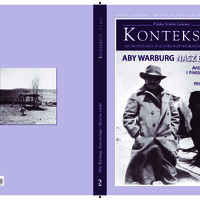
�Fot. Aby Warburg. California, luty 1896 Za: Photographs at the Frontier. Aby Warburg in America 1895-96,
ed. B. Cestelli Guidi, N. Mann, Londyn 1998, s. 87
Fot. Aby Warburg. Chinatown, San Francisco, luty 1896. Za: Photographs at the Frontier. Aby Warburg in America 1895-96,
ed. B. Cestelli Guidi, N. Mann, Londyn 1998, s. 90
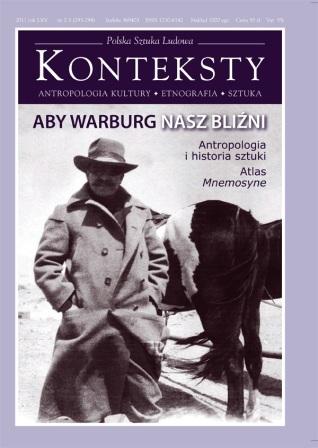
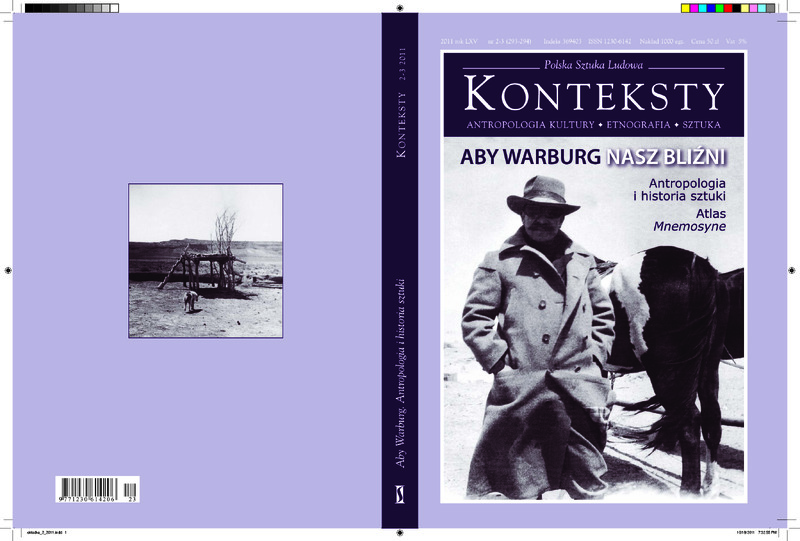
Okładka: Aby Warburg podczas burzy piaskowej, Arizona, kwiecień 1896. Za: Photographs at the Frontier. Aby Warburg
in America 1895-96, ed. B. Cestelli Guidi, N. Mann, Londyn 1998, s. 113
Czwarta strona okładki: Fot. Aby Warburg. Krajobraz z drabiną i psem, Arizona, kwiecień 1896.
Za: Photographs at the Frontier. Aby Warburg in America 1895-96, ed. B. Cestelli Guidi, N. Mann, Londyn 1998, s. 114
Redakcja Kontekstów:
Redagują: Zbigniew Benedyktowicz (redaktor naczelny), Aleksander Jackowski, Danuta Benedyktowicz (sekretarz redakcji),
Justyna Chmielewska, Dariusz Czaja, Wojciech Michera, Maciej Rożalski, Czesław Robotycki, Tomasz Szerszeń
Doradcy i recenzenci:
Jerzy Bartmiński, Antoni Kroh, Ludwik Stomma, Roch Sulima, Zofia Bisiak
Projekt graficzny: Wojciech Markiewicz
Projekt okładki i opracowanie graficzne numeru: Andrzej Łubniewski
Adres redakcji: Instytut Sztuki PAN, ul. Długa 26/28, 00-950 Warszawa,
skr. poczt. 994, tel. (+48 22) 50 48 243
tel./fax (+48 22) 50 48 296; e-mail: konteksty@ispan.pl; www.konteksty.pl
Wydawcy: Instytut Sztuki PAN, Stowarzyszenie Liber Pro Arte, Narodowe centrum kultury
Kwartalnik Konteksty dostępny jest w wersji elektronicznej pod adresem: http://www.ceeol.com/aspx/publicationlist.aspx
prenumerata „kontekstów” za 2011
Półroczna - 50 zł
Roczna - 100 zł
Warunki prenumeraty przez
„RUCH” SA O. K. D. P.
Prenumerata krajowa: Wpłaty na
prenumeratę przyjmują jednostki
kolportażowe „RUCH” SA
właściwe dla miejsca zamieszkania.
Termin przyjmowania wpłat na prenumeratę
krajową – do 5 każdego miesiąca
poprzedzającego okres rozpoczęcia
prenumeraty.
Prenumerata opłacana w złotówkach
ze zleceniem wysyłki za granicę: Informacji
o warunkach prenumeraty i sposobie
zamawiania udziela „RUCH” SA
Oddział Krajowej Dystrybucji Prasy,
01-248 Warszawa, ul. Jana Kazimierza 31/33,
telefony 22 5328-731, 5328-816, 5328-819,
5328-820
infolinia 0-800-1200-29
wpłaty na konto w banku PEKAO SA IV O/
Warszawa
Nr 12401053-40060347-2700-401112-005
lub kasa Oddziału.
Dokonując wpłaty za prenumeratę w Banku
lub w Urzędzie Pocztowym należy podać:
nazwę firmy kolportażowej, nazwę banku,
numer konta, czytelny pełny adres odbiorcy
za granicą, okres prenumeraty, rodzaj wysył
ki (p-tą lot. czy zwykłą) oraz zamawiany
tytuł.
Warunkiem rozpoczęcia wysyłki prenumera
ty jest dokonanie wpłaty na konto „RUCH”.
Prenumerata opłacana w dewizach
przez odbiorcę z zagranicy:przelewem na
konto w banku w USD PEKAO SA IV O/W-wa
12401053-40060347-2700-457872-001
w EUR PEKAO SA IV O/W-wa
12401053-40060347-2700-459782-001
Po dokonaniu przelewu prosimy o przesłanie
kserokopii polecenia przelewu z podaniem
adresu i tytułu pod nr faxu
+ 48 22 532-87-32
Opłaty za prenumeratę można dokonać
również czekiem wystawionym na firmę
„RUCH SA OKDP” i przesłanym razem
z zamówieniem, listem poleconym,
na adres „RUCH”.
Informujemy, że klienci płacący z zagranicy
mogą też dokonać wpłaty na prenumeratę
kartami kredytowymi VISA i MASTER
CARD w internecie http://www.ruch.pol.pl.
CENTRALA HANDLU ZAGRANICZNEGO
ARS POLONA
03-933 Warszawa, Obrońców 25, Polska
tel.: 22 509-86-00, fax: 509-86-48
e-mail: arspolona@arspolona.com.pl
VAT No: PL 5251700016
Sprzed aż prow ad zi równ ież
Dział Wydawniczy Instytutu Sztuki PAN,
00-950 Warszawa, ul. Długa 28,
tel. 22 50 48 274
www.ispan.pl
iswydawnictwo@ispan.pl
Sprzedaż na rachunek, za zaliczeniem
pocztowym lub za gotówkę
w Dziale Wydawniczym
oraz w kiosku Instytutu Sztuki.
Również numery archiwalne.
Skład i łamanie: Łukasz Pruszko.
okładka_2_2011.indd 2
10/18/2011 7:33:01 PM
�
-
noty.ps - 10/18/2011 6:36 PM
Noty o autorach
Giorgio Agamben – włoski filozof, jeden z czołowych
współczesnych intelektualistów europejskich. Autor
wielu książek, z których po polsku ukazały się: Profanacje (2006), Homo sacer. Suwerenna władza i nagie życie (2008), Co zostaje z Auschwitz (2008), Wspólnota,
która nadchodzi (2008), Stan wyjątkowy (2009), Czas,
który zostaje (2009), Nagość (2010).
Zbigniew Benedyktowicz – antropolog kultury, adiunkt w Instytucie Etnologii i Anropologii Kulturowej
UW, pracuje w Instytucie Sztuki PAN w Warszawie.
Redaktor naczelny kwartalnika „Konteksty”, członek
redakcji „Kwartalnika Filmowego”. Zajmuje się problematyką wyobraźni symbolicznej i antropologią kultury współczesnej. Autor licznych artykułów na ten
temat, współautor i redaktor naukowy książek: Film
i kontekst (1988); Sztuka na wysokości oczu. Film i antropologia (1991), Zbigniew Rybczyński – podróżnik do
krainy niemożliwości (1993), autor książek z zakresu
antropologii kultury: Dom w tradycji ludowej [z Danutą Benedyktowicz] (1992), Portrety „Obcego”. Od stereotypu do symbolu (2000), Dom – droga istnienia. Dom
w tradycji ludowej [w: 7 Triennale Sztuki Sacrum Dom –
droga istnienia. Miejska Galeria Sztuki w Częstochowie, Częstochowa 2009, The Home – the Way of Being.
The Home in Folk Tradition [z Danutą Benedyktowicz], Częstochowa 2009.
Ludwig Binswanger (1881–1966) – szwajcarski psychiatra, psychoanalityk. W psychoterapii stosował
niektóre zasady fenomenologii egzystencjalnej. Prowadził klinikę w Kreuzlingen. Napisał m. in.: Grundformen und Erkenntnis menschlichen Daseins (1962)
i Erinnerung an Sigmund Freud (1956) – wspomnienie
swej przyjaźni z Freudem.
Piotr Borowski – aktor i reżyser teatralny. Twórca
niezależnej warszawskiej sceny „Studium Teatralne”
na Lubelskiej 30/32 na warszawskiej Pradze. W działalność teatralną zaangażowany jest od 1975 roku,
kiedy związał się z teatrem „Laboratorium” Jerzego
Grotowskiego. Brał udział m. in. w przygotowaniach
i realizacji Uniwersytetu Poszukiwań Teatru Narodów
we Wrocławiu. W latach 1977-83 był aktorem i muzykiem w grupie teatralnej „Gardzienice” prowadzonej
przez Włodzimierza Staniewskiego. Po wyjeździe do
Włoch, w latach 1985-1993, Borowski pracował
w Ośrodku Jerzego Grotowskiego w Pontederze.
W 1995 roku prowadził warsztaty teatralne w CSW
w Warszawie. W 1996 roku założył niezależną grupę
teatralną Studium Teatralne, z którą zrealizował szereg przedstawień.
Benjamin Buchloh – historyk i teoretyk sztuki współczesnej, profesor na uniwersytecie Harvarda, redaktor
pisma „October”. Napisał: Neo-Avantgarde and Cultu-
ral Industry (2000), Art Since 1900 (współautor,
2004). Obecnie pracuje nad monografią Gerharda
Richtera (Gerhard Richter: Painting After the Subject of
History). Jest autorem wielu tekstów krytycznych m.
in. o międzywojennej awangardzie.
Giovanni Careri – historyk sztuki, wykładowca
w Ecole des Hautes Etudes en Sciences Sociales
(EHESS) w Paryżu i w Centre d’Histoire et Théorie
des Arts (CEHTA), profesor w Ecole des Beaux-Arts
w Lyonie. Napisał m. in.: Envols d’amour. Le Bernin
montage des arts et dévotion baroque (1990), La Jérusalem délivrée du Tasse. Poésie, peinture, musique, balet
(1999), Gestes d’amour et de guerre (2005).
Benedetta Cestelli Guidi – historyczka sztuki, wykładowczyni na uniwersytecie La Sapienza w Rzymie. Współpracowała z Instytutem Warburga przy
opracowywaniu fotografii z podróży Warburga do
Ameryki. Współredagowała Photographs at the Frontier: Aby Warburg in America 1895-1896 (Londyn
1998).
Jerzy Ćwiertnia (1928-2009) – malarz, grafik, filozof.
W latach 1947-53 studiował na Wydziale Malarstwa
warszawskiej ASP w pracowni Aleksandra Rafałowskiego. Uczestniczył w Ogólnopolskiej Wystawie Młodej Plastyki pod hasłem „przeciw wojnie – przeciw faszyzmowi” zorganizowanej w warszawskim Arsenale.
Był redaktorem graficznym i publicystą legendarnego
czasopisma „Po prostu”. Po jego zawieszeniu porzucił
malarstwo dla studiów nad filozofią i religiami Indii
i Dalekiego Wschodu oraz nauki sanskrytu. Do malarstwa powrócił ok. 1966. Wystawiał niezwykle rzadko.
Do najważniejszych wystaw, w których wziął udział,
należą: Świadectwa obecności (Kościół NMP w Warszawie); Współczesna Sztuka Sakralna z Polski (Eisenstadt, Austria); Biblia we współczesnym malarstwie polskim – przeżycia – inspiracje – ślady (Muzeum
Narodowe w Gdańsku); Formacja artystyczna Arsenał
55 (Muzeum w Gorzowie Wielkopolskim, 2005). Indywidualnie wystawiał w Galerii Historyków Sztuki
371
�noty.ps - 10/18/2011 6:36 PM
NOTY O AUTORACH
w Warszawie oraz w Zachęcie. Muzeum Okręgowe
w Sandomierzu na przestrzeni lat 1994-2008 wielokrotnie organizowało prezentacje jego twórczości malarskiej, po raz ostatni na wystawie jubileuszowej
w 2008 roku, z okazji 80-lecia urodzin artysty.
Małgorzata Dziewulska – eseistka, pisarz teatralny.
Wykłada na Wydziale Wiedzy o Teatrze Akademii
Teatralnej w Warszawie. Autorka licznych publikacji
o teatrze oraz książek m. in. Teatr zdradzonego przymierza, Artyści i pielgrzymi i Inna obecność.
Georges Didi-Huberman – filozof i historyk sztuki.
Wykładowca w Ecole des Hautes Etudes en Sciences
Sociales (EHESS) w Paryżu. Autor wielu książek dotyczących filozofii i antropologii obrazu, a także sztuki
współczesnej i renesansowej, m. in.: Invention de
l’hystérie (1982), Devant l’image. Questions posées aux
fins d’une histoire de l’art (1990), La Ressemblance informe, ou Le gai savoir visuel selon Georges Bataille (1995),
Devant le temps (2000). Po polsku ukazały się: Obrazy
mimo wszystko (2009) i Strategie obrazów. Oko historii
(2011). Jest autorem wielu tekstów reinterpretujących
spuściznę Warburga, w tym książki L’Image survivante
(2002).
David Freedberg – historyk sztuki, profesor na Uniwersytecie Columbia. Prowadzi badania nad ikonoklazmem i cenzurą, a także odbiorem dzieł sztuki. Znawca dawnej sztuki flamandzkiej i holenderskiej,
zajmował się również sztuką współczesną. Po polsku
ukazała się Potęga wizerunków. Studia z historii i teorii
oddziaływania (2005). Wydał m. in.: Dutch Landscape
Prints of the Seventeenth Century (1980), Rubens: The
Life of Christ after the Passion (1984), Iconoclasts and
Their Motives (1984), Art History, History in Art: Studies in Seventeenth-Century Dutch Culture (1992), The
Eye of the Lynx: Galileo, His Friends, and the Beginnings
of Modern Natural History (2002).
Jacek Dobrowolski – poeta, tłumacz, eseista i krytyk
urodzony pod znakiem Wierzby. Wydał tomiki poezji
Raróg i Partytury oraz komedię romantyczną Dziewanna. Publikował w: „Kulturze” (debiut u St. Grochowiaka), „Współczesności”, „Teatrze”, „Res Publice
Nowej”, „Odrze”, „Kontekstach”, „Rzeczpospolitej”,
„Gazecie Wyborczej”, „The Journalist’s Handbook”,
„The Irish Times”, „The European Quarterly”. Pionier tłumaczenia książek o medytacji zen. Autor scenariusza filmu Zaćmienie piątego słońca (TVP, 1991).
Od 1975 tłumacz mistrzów zen, naukowców (Vittorino Andreoli, Walter Burkert, Simon Goldhill, Richard Seaford, Richard Schechner, Oliver Taplin,
Martin West, Stephanie West, Andrzej Wierciński)
oraz artystów teatru (Eugenio Barba, Pina Bausch,
Grzegorz Bral, Peter Brook, Ariel Dorfman, Jon Fosse,
Peter Greenaway, Christopher Hampton, David Pountney, Peter Schumann, Włodzimierz Staniewski,
Ellen Stewart, Józef Szajna, Robert Wilson). Współpracownik BBC od 1989. Otrzymał brązowy medal
„Gloria Artis” w 2005.
Julián Gastelo – antropolog kultury, filmowiec–dokumentalista.
Marta Dziewańska – absolwentka wydziału filozofii
Uniwersytetu Paris I-Sorbonne. Pracowała w paryskim Centre Pompidou, od 2007 w Muzeum Sztuki
Nowoczesnej w Warszawie jako kurator badań i publikacji. Współredaktorka, z Claire Bishop, książki 19681989. Momenty zwrotne w polityce i sztuce (MSN,
2009), redaktorka Ion Grigorescu. W ciele ofiary
(MSN, 2010). Uczestniczyła w przygotowaniu wystaw: Niezgrabne przedmioty. Alina Szapocznikow i Maria Bartuszova, Pauline Boty, Louise Bourgeois, Eva Hesse, i Paulina Ołowska (MSN 2009) i Ion Grigorescu.
W ciele ofiary. 1969-2008 (MSN 2009). W 2011
współpracuje przy wystawie Alina Szapocznikow. Sculpture Undone (WIELS, Bruksela).
Ireneusz Guszpit – nauczyciel akademicki w Zakładzie Teorii Kultury i Sztuk Widowiskowych Instytutu
Filologii Polskiej Uniwersytetu Wrocławskiego, oraz
na Wydziale Aktorskim wrocławskiej PWST; miłośnik teatru i biegów maratońskich.
Jacek Jaźwierski – historyk sztuki, dr, adiunkt w Katedrze Teorii Sztuki i Historii Doktryn Artystycznych
Instytutu Historii Sztuki KUL. Zajmuje się badaniem
dziejów myśli o sztuce.
Wiesław Juszczak – historyk sztuki, filozof, profesor
Instytutu Historii Sztuki Uniwersytetu Warszawskiego
i Instytutu Sztuki PAN. Wybitny znawca malarstwa
polskiego XIX i XX w. Obecnie jego główne zainteresowania badawcze to filozofia sztuki oraz historia religii. Opublikował m. in. Wojtkiewicz i nowa sztuka
(1965); Jan Stanisławski (1972); Postimpresjoniści
(1973); Malarstwo polskie: modernizm (1977); Młody
Weiss (1979); Fakty i wyobraźnia (1979); Zasłona w rajskie ptaki albo „O granicach: okresu powieści” (1981);
Fragmenty. Szkice z teorii i filozofii sztuki (1995), przekładał m. in. Eliota, Blake’a, Karen Blixen. Ostatnio
wydał: Pani na żurawiach. Tom 1: Realność bogów
(2002), Malarstwo polskiego modernizmu (2005) i zbiór
tekstów Wędrówka do źródeł (2010). W 2010 roku został uhonorowany nagrodą polskiego PEN Klubu im.
Ksawerego i Mieczysława Pruszyńskich.
Ryszard Kasperowicz – dr hab., prof. KUL, kierownik
Katedry Teorii Sztuki i Historii Doktryn Artystycznych KUL. Opublikował m. in. Berenson i mistrzowie
Odrodzenia. Przyczynek do postawy estetycznej Bernarda
372
�noty.ps - 10/18/2011 6:36 PM
NOTY O AUTORACH
Berensona (Kraków 2000), Zweite, ideale Schöpfung.
Sztuka w myśleniu historycznym Jacoba Burckhardta (Lublin 2004). Przełożył i opatrzył wstępem tom esejów
Warburga Narodziny Wenus (Gdańsk 2010).
Ewa Klekot – antropolożka i tłumaczka, adiunkt w Instytucie Etnologii i Antropologii Kulturowej UW. Zajmuje się antropologią sztuki, a zwłaszcza zagadnieniami różnicującego potencjału sztuki w społeczeństwie
nowoczesnym oraz materialnością rzeczy uznawanych
za sztukę. Autorka licznych tłumaczeń książek i tekstów z zakresu antropologii i historii kultury.
Joseph Leo Koerner – profesor na Wydziale Historii
Sztuki i Architektury Uniwersytetu Harvarda, członek American Academy of Arts and Sciences oraz
American Philosophical Society. Wybitny znawca
sztuki niemieckiego renesansu. Opublikował m. in.
Dürer’s Hands, New York 2006; The Reformation of the
Image, London-Chicago 2004; The Moment of Self-Portraiture in German Renaissance Art, Chicago 1993;
Paul Klee. Legends of the Sign, New York 1991; Caspar
David Friedrich and the Subject of Landscape, New Haven-London 1990. Publikował w „Kontekstach”
w numerze 1/2010.
Magdalena Kraszewska – absolwentka ASP w Warszawie na wydziale malarstwa w pracowni prof. Artura Nachta Samborskiego i jednocześnie w pracowni
tkaniny artystycznej prof. Aliny Śledziewskiej. Obecnie zajmuje się rysunkiem i malarstwem akwarelowym. Jej prace znajdują się w rękach prywatnych oraz
w zbiorach Biblioteki Narodowej i Muzeum Tatrzańskiego. Od 1993 roku prowadzi Galerię Sztuki Współczesnej w domu rodzinnym w Zakopanem, gdzie odbywają się wystawy indywidualne i zbiorowe, koncerty,
promocje książek, zebrania stowarzyszeń i wieczory
poezji.
Andrzej Leśniak – historyk sztuki, absolwent Szkoły
Nauk Społecznych PAN. Adiunkt w Katedrze Kultury Współczesnej UJ. Pracował w Muzeum Sztuki
w Łodzi, wykładał w Instytucie Historii Sztuki i w Instytucie Kultury Polskiej Uniwersytetu Warszawskiego; przygotował cykl wykładów o teoriach nowoczesności dla Muzeum Sztuki Nowoczesnej w Warszawie.
Jest autorem książki Obraz płynny. Georges Didi-Huberman i dyskurs historii sztuki (Kraków 2010).
Krzysztof Lipka – muzykolog, historyk sztuki, eseista,
autor książek: Wariacje z fletem, Usta i kamień, Elegie
moszczenickie, Wszystko przez Schuberta.
Iwona Luba – dr historii sztuki, kierownik Zakładu
Historii Sztuki i Kultury Nowoczesnej UW, adiunkt
w Akademii Sztuk Pięknych w Warszawie.
Goshka Macuga – artystka. Urodzona w Polsce, studiowała w Central Saint Martins School of Art
i w Goldsmiths College w Londynie. W 2008 roku
znalazła się w gronie czterech nominowanych do prestiżowej Turner Prize, przyznawanej najwybitniejszym
młodym brytyjskim artystom. Mieszka i pracuje
w Londynie. Jej metoda pracy wykracza poza tradycyjnie pojmowaną rolę artysty: „Jestem artystką, która
próbuje rozszerzyć swoje działania o bycie kuratorem,
historykiem, opowiadaczem historii, krytykiem, archiwistą, projektantem wystaw, architektem, kompozytorem, galerzystą, socjologiem, biologiem, filmowcem,
kolekcjonerem, fotografem, performerem, magikiem
itd. ” mówi o sobie. W ostatnich realizacjach Macuga
w bardziej jednoznaczny sposób odnosi się do sfery polityki. Jej wystawa I Am Become Death w Bazylei
w 2009 roku obracała się wokół problemu neokolonialnej polityki Stanów Zjednoczonych. Artystka zestawiła m. in. zdjęcia Indian Hopi autorstwa Warburga i archiwum zdjęć amerykańskiego weterana wojny
w Wietnamie. Dominantę instalacji stanowiły rekonstrukcje rzeźb Roberta Morrisa z jego wystawy w Tate
Gallery w 1971 roku. Miała wystawy indywidualne m.
in. w Tate Britain (Londyn, 2007), Kunsthalle Basel
(Bazylea, 2009), Whitechapel Gallery (Londyn, 200910); brała udział w Biennale Sztuki w Wenecji (2009).
Chantal Marazia – dr filozofii, przygotowała rozprawę
doktorską o Ludwigu Binswangerze. Wraz z Davide Stimillim przygotowała do druku materiały dotyczące historii klinicznej Warburga i jego pobytu w Kreuzlingen.
Katia Mazzucco – w 2006 roku obroniła doktorat dotyczący projektu Mnemosyne Aby’ego Warburga.
Obecnie pracuje jako wykładowca na uniwersytetach
Ca’ Foscari i IUAV w Wenecji. Była współkuratorem
wystawy Atlasu Mnemosyne w Wenecji (2004). Jest
autorem tekstów w książkach i pismach m. in.: Introduzione ad Aby Warburg e all’Atlante della Memoria
(wraz z Kurtem W. Forsterem, 2002); Prefazione, [w]:
Ernst H. Gombrich, Aby Warburg. Una biografia intellettuale (2003); Coordinate di metodo. Un esempio: Aby
Warburg (2005); Uwagi do tekstów, [w]: Aby Warburg, Narodziny Wenus (2010).
Philippe-Alain Michaud – historyk i teoretyk sztuki,
kurator działu filmu w Centre Pompidou w Paryżu.
Bada pogranicza historii sztuki, antropologii i kina.
Jest autorem książek: Aby Warburg et l’image en mouvement (1998, wyd. ang. 2004) i Sketches. Histoire de
l’art, cinema (2006). Był kuratorem i współ-kuratorem
wielu wystaw w Centre Pompidou m. in.: Image en mouvement (2006) i La subversion des images (2009).
Monika Milewska – antropolog historii, eseistka, poetka, dramaturg. Adiunkt w Zakładzie Etnologii Wy-
373
�noty.ps - 10/18/2011 6:36 PM
NOTY O AUTORACH
działu Historycznego UG. Ukończyła z wyróżnieniem
Wydział Historyczny Uniwersytetu Warszawskiego,
gdzie doktoryzowała się w 2000 roku, Szkołę Nauk
Społecznych przy Instytucie Filozofii i Socjologii PAN
oraz Ecole des Hautes Etudes en Sciences Sociales
w Paryżu. Sekretarz Gdańskiego Oddziału Stowarzyszenia Pisarzy Polskich. Stypendystka m.in. Ministra
Kultury, Ministra Edukacji Narodowej, Rządu Francuskiego, Rządu Włoskiego. Autorka m.in. eseistycznej książki Ocet i łzy. Terror Wielkiej Rewolucji Francuskiej jako doświadczenie traumatyczne (słowo/obraz
terytoria, Gdańsk 2002), która przyniosła jej stypendium „Polityka” i nominację do Nagrody Literackiej
NIKE. Obecnie przygotowuje książkę o kulcie jednostki od Aleksandra Wielkiego do Kim Jong Ila.
Allgemeine Zeitung”, członek prezydium Goethe-Institut. Autor krytycznej niemieckiej edycji: Aby Warburg, Schlangenritual. Ein Reisebericht (Berlin 1988).
Paweł Mościcki – filozof, tłumacz. Doktorant w Instytucie Filozofii i Socjologii PAN. Laureat stypendium Fundacji Kościuszkowskiej w roku 2007/2008.
Zredagował książkę Maurice Blanchot – literatura ekstremalna (2006) i napisał dwie inne: Polityka teatru.
Eseje o sztuce angażującej (2007) oraz Godard. Pasaże
(2010). Przygotowuje doktorat o pojęciu potencjalności w pismach włoskiego filozofa Giorgio Agambena
oraz książkę poświęconą pojęciu utopii w historii politycznej i artystycznej ubiegłego stulecia.
Krzysztof Rutkowski – pisarz, eseista, tłumacz, dziennikarz. Historyk literatury romantycznej, profesor
Uniwersytetu Warszawskiego. W 1989 otrzymał Nagrodę im. Kościelskich. Tłumaczył m. in. książki Pascala Quignarda i Daniela Beauvois. Opublikował m.
in. Braterstwo albo śmierć. Zabijanie Mickiewicza w Kole Sprawy Bożej (1988), Stos dla Adama albo Kacerze
i kapłani (1994), Paryskie pasaże. Opowieść o tajemnych
przejściach (1995), Mistrz. Widowisko (1996), Raptularz końca wieku (1997), Książę bezdomny (1999), Kościół św. Rocha. Przepowieści (2001), Zakochany Stendhal. Dziennik wyprawy po imię (2005), Ostatni pasaż.
Przypowieść o byciu byle-jakim (2007), Requiem dla moich ulic (2008), Wokulski w Paryżu (2010).
Emilia Olechnowicz – w Instytucie Sztuki PAN przygotowuje doktorat o angielskich widowiskach dworskich.
Pracuje w Instytucie Dokumentacji i Studiów nad Literaturą Polską. Autorka książki Promieniowanie. Strony ze
szkicowników Zbigniewa Herberta (2009), redaktorka
albumu Józef Czapski. Wybrane strony (2010).
Katarzyna Prot – psychiatra i psychoterapeutka. Kieruje Centrum Zdrowia Psychicznego w Instytucie Psychiatrii i Neurologii w Warszawie. Specjalne obszary
zainteresowań to psychiatria środowiskowa i psychologiczne konsekwencje wydarzeń traumatycznych.
Jest autorką wielu artykułów fachowych, monografii
Życie po Zagładzie oraz współautorką książki Psychiatria
Środowiskowa jako środowiskowa opieka nad zdrowiem
psychicznym.
Renata Rogozińska – historyczka sztuki, etnograf,
profesor ASP w Poznaniu. Zainteresowania badawcze
koncentruje na problematyce współczesnej sztuki religijnej i sakralnej. Opublikowała wiele artykułów w katalogach wystaw, książkach oraz czasopismach, takich
jak „Konteksty”, „W drodze”, „Przegląd Powszechny”,
„Kresy”, „Czas kultury”, „Gazeta malarzy i poetów”,
Rzeźba Polska”, „Format”. Jest autorem książek
W stronę Golgoty. Inspiracje pasyjne w sztuce polskiej
w latach 1970-1999 (2002) i Ikona w sztuce XX wieku
(2009).
Małgorzata Sobieraj – historyk sztuki. Pracowała najpierw w Zakładzie Sztuki Nowoczesnej na UJ, a następnie (do dziś) w Instytucie Sztuki PAN. Pracowała
również w redakcji „Biuletynu Historii Sztuki”. Doktorat otrzymała na podstawie dysertacji o związkach
sztuki z polityką w dwudziestoleciu międzywojennym.
Zajmuje się m. in. twórczością Artura Grottgera i Jacka Malczewskiego.
Matthew Rampley – badacz sztuki XIX i XX wieku, zajmuje się zagadnieniami kultury wizualnej. Wykładowca
wydziału historii sztuki na Uniwersytecie w Birmingham. Wydał m. in.: Nietzsche, Aesthetics and Modernity
(2000), In Remembrance of Things Past: Aby M. Warburg
and Walter Benjamin (2000). Jest redaktorem prac zbiorowych Exploring Visual Culture (2005) i Art History and
Visual Studies in Europe. A Critical Guide (w druku).
Joanna Sosnowska – dr hab. historyk sztuki, docent
w Instytucie Sztuki PAN w Warszawie. Ukończyła
studia na Uniwersytecie Warszawskim, doktoryzowała
się w Instytucie Sztuki PAN, tam też uzyskała habilitację w 2004 roku. Wykłada na ASP w Warszawie.
Zajmuje się polską sztuką XIX i XX wieku. Wydała
Materiały do dziejów Instytutu Propagandy Sztuki
(1930–39), Polacy na Biennale Sztuki w Wenecji
1895–99 oraz Poza kanonem. Sztuka polskich artystek
1880–39. Publikowała m. in. w„Biuletynie Historii
Sztuki”, „Twórczości”, „Kresach”, „Znaku”, „Architekturze”.
Ulrich Raulff – filozof, historyk i dziennikarz. Dyrektor Archiwum Literatury Niemieckiej w Marbach.
Wieloletni redaktor działu kulturalnego „Frankfurter
Davide Stimilli – profesor literatury niemieckiej. Wykładał na wielu uniwersytetach we Włoszech
i w USA. Jest autorem Fisionomia di Kafka (2001), The
374
�noty.ps - 10/18/2011 6:36 PM
NOTY O AUTORACH
Face of Immortality: Physiognomy and Criticism (2004),
a także redaktorem zbioru niepublikowanych tekstów
Warburga „Per Monstra ad Sphaeram” (2005) i materiałów dotyczących historii klinicznej Warburga i jego
pobytu w Kreuzlingen (wyd. włoskie, hiszpańskie,
francuskie, niemieckie).
Monika Szewczyk – krytyczka i kuratorka sztuki
współczesnej. Współpracuje m.in. z pismami „A Prior”
i „Afterall”, a także licznymi ośrodkami sztuki w Niemczech i Holandii. Jest szefem publikacji w Centrum
Sztuki Współczesnej Witte de With w Rotterdamie,
współpracowała też z Vancouver Art Gallery.
Przemysław Strożek – doktor nauk humanistycznych, pracownik Instytutu Sztuki PAN. Specjalizuje
się w historii i historiografii awangardy ze szczególnym
uwzględnieniem badań nad włoskim futuryzmem.
Członek European Network for Avant-garde and Modernist Studies oraz zaangażowany w sieć tworzenia
międzynarodowych studiów nad futuryzmem: współautor przygotowywanej publikacji International Yearbook of Futurist Studies. Vol. 1. (De Gruyter,
2011). Publikował też m. in. na łamach „Pamiętnika
Teatralnego”, „Przeglądu Humanistycznego”, „Biuletynu Historii Sztuki”.
Kuba Szpilka – etnolog (studia UJ), studia doktoranckie Instytut Sztuki PAN, pisze pracę doktorską
poświęconą etnologicznej interpretacji kultury masowej. Mieszka w Kościelisku.
Tomasz Szerszeń – antropolog kultury i fotograf. Redaktor „Kontekstów”. Absolwent MISH na UW, Studium Doktoranckiego w Instytucie Sztuki PAN i Fotografii w PWSFTViT w Łodzi. Był stypendystą:
Fundacji na Rzecz Nauki Polskiej (2010), Stypendium
Artystycznego m.st. Warszawy (2010), Ministerstwa
Kultury i Dziedzictwa Narodowego (2007), Stypendium Rządu Francuskiego (2006, 2008). Publikował
m.in. w „Literaturze na Świecie”, „Kontekstach”, „Tygodniku Powszechnym”, „Kwartalniku Filmowym”,
„Res Publice Nowej”, „Dwutygodniku” i w antologii
Przekleństwa wyobraźni (Kraków, 2010). W listopadzie
2010 w Galerii Wymiany w Łodzi odbyła się prezentacja jego projektu artystycznego Byłem pierwszym polskim surrealistą. Prace z lat 1929-39.
Summaries
Tomasz Szerszeń Aby Warburg, Our Neighbour
Georges Didi-Huberman called Warburg „our obsession”, a Dibbuk that continues to haunt us. The
years-long successive work on an enormous archive –
Warburg’s bequest – revealing not only an outline of
Andrzej Turowski – historyk sztuki współczesnej.
Profesor emerytowany Uniwersytetu Burgundzkiego
w Dijon (1990-2009), doktor honoris causa Akademii
im. Strzeminskiego w Łodzi (2004), dyrektor Centre
de Recherche Comparative sur les Avant-gardes
(1990-2000), współdyrektor Galerii Foksal w Warszawie (1970-1983). Jest autorem licznych artykułów,
rozpraw i książek m. in: Konstruktywizm polski (1981),
Wielka utopia awangardy (1990), W kręgu konstruktywizmu (1976), Exit-t-il un art de l’Europe de l’Est
(1986), Budowniczowie świata. Z dziejów radykalnego
modernizmu (2000), Awangardowe marginesy (1998),
L’art et le discours face à la revolution (red., 1998), Arts
et artistes autour de Zervos (red., 1998), Między sztuką
i komuną (red., 1998). Wydał też monografie Jerzego
Kujawskiego i Kazimierza Malewicza. Kurator wielu
wystaw, m. in.: L’Europa dei razionalisti, Milano/Como
1989; Europa, Europa, Bonn 1994; Fin des temps! L’histoire n’est plus, Toulon 2004; Svegliato e sogna, Wenecja 2009.
never completed projects and the scale of quests but
also the history of a mental illness and an amazing return to health, became entangled with interest in
Warburg’s legacy, growing since the 1980s; thus at
the end of the twentieth century, Warburg, little
known during his lifetime, became, an emblematic figures of the contemporary humanities. This unexpected revival, „life after life”, so well inserted into the
„phantomatic model” of history construed by him, testifies not only to the belated discovery of his opus.
From the present-day view the impossibility of delineating the boundaries of the Warburg project appears
to be particularly intriguing, and its open form means
that writing today about his work signifies accepting
that one day our hypotheses and interpretations will
be modified or undermined.
Andrzej Turowski History of Art in an Age of Madness
History of art, as formulated by Warburg, comprised
375
�noty.ps - 10/18/2011 6:36 PM
SUMMARIES
a critical reference to the beginnings of the discipline
where not only the name but also the object of research and the method defined their sense and limits.
Such critique was paradigmatic and questioned the
epistemological foundations and methodological discourses of the „scientific” history of art. Taking into
consideration this basic transformation we must become aware of the fact that due to Warburg the „first history of art” based on an Enlightenment model was replaced by a „second history of art”, which came into
being in the psychiatric clinic and on the excavation
site of memory. The first emerged under the sign of
the Sun, while the second turned towards the melancholy of Saturn. Its centre was the motif of the threat
looming over man and the experience of a permanent
crisis.
Krzysztof Rutkowski Warburg and the Snake
This literary-biographical-philosophical passage shows
Warburg as a borderline figure constantly crossing the
boundaries between „science”, „art” and „life”, torn
between Apollo and Dionysius, between pagan antiquity and modernity, between health and mental illness...
Aby Warburg Seismographies
Two fragments concerning Seismographs (Burckhardt,
Nietzsche, Warburg), sensitive to motions concealed
for the contemporaries and the transferences to
which culture has been subjected.
Aby Warburg Burckhardt and Nietzsche
A fragment from the Warburg dairies on two models
„clairvoyance” in German-language culture upon the
thershold of modernity.
Tomasz Szerszeń Demons of War according to
Warburg. Kriegskartothek
The reaction of Warburg to the horror and destruction
of the 1914-1918 period assumed the form of an attempt at creating „war iconography” (a large collection
of photographs, postcards and maps) and overcoming
with their assistance images of the „demons” of war: anti-Semitism and nationalism.
Richard Kasperowicz The Image in the Conception by
Aby Warburg
The concept of the „image” assumed a key rank in the
interpretations proposed by Aby Warburg. The latter
did not accept the universally applied description, silently approved in the second half of the nineteenth
century, which either referred to assorted formalistic
aesthetics that granted autonomy to the form of the
artwork, or situated the form in an abstractly constructed system of the development of historical
forms. Warburg conceived the image as the outcome
of a complex historical situation in which the artist’s intentions play a role just as essential as the needs of the patron or the certain mental inclinations of
a milieu and inherited traditions. Constructing the
image crosses the demands of aesthetics and is enrooted in a convoluted psychological process, indicating
the anthropological justification of the image as
man’s cultural-biological function. At the time this
stand did not have a counterpart in the „classical” history of art and owed much to studies into religion
and the myth, consistently aiming at an interpretation
of art as the history of man’s visual expression transcending the traditional rigid rules of aesthetics.
Aby Warburg Images from the Region of the Pueblo Indians of North America
A famous lecture given by Warburg in a mental
hospital in Kruzlingen and concerning his „initiation”
trip to America.
Katia Mazzucco Bilder, Reise, Schlangenritual...
Aby Warburg’s journey in late nineteenth century in
Arizona and New Mexico Pueblo villages, and the influence of this experience on his theory of symbolic
thought and his research methodology, are inextricably connected both with the clinical story of the scholar and the rhapsodic editorial success of his writings.
The lecture Aby Warburg gave in Kreuzlingen in
1923 on Hopi Indians rituals remains the best known
of Warburg writings and places his studies among the
earliest contributions to modern inter-disciplinary
Cultural Studies. Bibliographic notes collected in this
paper trace the main editions of the Kreuzlinen lecture and some of the most important critical works on
Warburg american trip, as a guideline for a correct
contextualization of the work.
Ewa Klekot Narratives on a certain voyage
Presumably, if Aby Warburg had not lectured on 21
April 1923 in Kreuzlingen on Images from the Pueblo
Territory in North America, the only writers interested in his trip in the South-West in 1895-1896 would have been his biographers. However, the fact
that Warburg, hospitalized in Kreuzlingen sanatorium, decided that the first lecture he was going to
deliver since his mental collapse in November 1918
would be based on his memories of the American
trip, put the powerful interpretative machine of modern humanities into motion. Since then different
narratives on his trip have appeared, based on different versions of his lecture (no one published during
his life and with his consent), his diary, letters and
photographs. However, the question why he had decided to delve in his American memories while preparing a lecture that was supposed to prove his mental stability remains open for speculations. One of
376
�noty.ps - 10/18/2011 6:36 PM
SUMMARIES
the reasons of this choice may have been Warburg’s entanglement in his German identity, that actually had been a direct cause of his collapse only
a month after the armistice of 1918.
Ulrich Raulff The Seven Skins of the Snake. Oraibi,
Kreuzlingen and Back: Stations on a Journey into Light
What was it that Warburg found so fascinating in the
figure of the snake, and what granted it incomparable
power – the power of semantic change? Apparently, it
is due to the possibility of changing its meaning that
the snake is capable of the very process of creating
a symbol. Hence it is not an unambiguously defined figure but precisely a symbol of ambivalence.
David Friedberg Warburg’s Mask. A Study in Idolatry
The presented text is an attempt at a critical analysis
of the American episode in Warburg’s life and associated literature, whose considerable part repeats the
same information and motifs; almost all publications
represent an uncritical approach. Warburg has been
rendered the object of idolatry as a pioneering example of combining the history of art and anthropology.
His example is an excellent lesson on the dangers lurking in the meeting point of the history of art and anthropology: it calls for a less hagiographic approach on
the part of the reader and more caution.
Benedetta Cestelli Guidi Aby Warburg and Franz Boas: Two Letters from the Warburg Archive. Correspondence between Franz Boas and Aby Warburg (19241925)
The correspondence between Aby Warburg and
Franz Boas casts interesting light on the dialogue involving the history of art and anthropology and conducted in the first decades of the twentieth century –
a crucial moment in the history of both disciplines.
The presented correspondence confirms the profundity and range of Warburg’s interest in cultural anthropology and his proclivity for obliterating the borderline between cultural anthropology and the history of
art as well as a readiness to transfer his library to the
USA.
Goshka Macuga, Julián Gastelo Snake Society
The outcome a journey taken in the footsteps of Warburg by the Polish-British artist is the film Snake Society, part of a larger project entitled I Am Become Death.
We present fragments of the film’s transcription,
which together with photographs comprise a photo-essay.
Monika Szewczyk Recorded Conversation with Goshka
Macuga
Ludwig Binswanger Letter to Sigismund Freud
Davide Stimilli Warburg’s Tincture
This text is a record of an „incomplete treatment” –
a cure applied at the hospital in Kreuzlingen – as well
as testimony of the extraordinary relation between
the psychiatrists (Ludwig Binswanger, Emil Kraepelin) and the patient (Warburg).
Chantal Marazia Ludwig Binswanger and the Ritual of
Healing
Aby Warburg spent three years being treated by the
famous psychiatrist Ludwig Binswanger. Historiography and philosophy perceive the Swiss psychiatrist as
the (co) founder of humanistic psychology, based on
listening, empathy, an encounter of the doctor and
patient, as well as „existential communication” between them. Meanwhile, the treated and ultimately
cured Warburg showed no signs of a return to health
that would also involve his physician. Quite possibly,
the reason for this state of things was the fact that
Binswanger had never truly engaged his ”I”...
Joseph Leo Koerner Lecture as Rite de Passage
The Warburg presentation still fascinates due to the
proximity between the author and the topic. In this
curious discourse European cultural identity is regained thanks to becoming close to the Other, envisaged as „madness” and „savagery”. Warburg actually
performs a transition ritual, in which the object of the
analysis turns into the observing subject. This autobiographical attitude assumes particular meaning in
the present-day state of research.
Aby Warburg Mnemosyne Atlas. Introduction
An introducion to Warburg’s The Mnemosyne Atlas.
Aby Warburg Manet’s ‘Déjeuner sur l’Herbe’...
The only completed commentary to The Mnemosyne
Atlas boards.
Katia Mazzucco Mnemosyne: Bilderdemonstration, Bilderreihen, Bilderatlas...
With the name Mnemosyne we can identify a great
project by Aby Warburg, which includes the collection and systematization of his library, devoted to the
mother of the Muses, his last unfinished book, the
Atlas, and also documents that testify a praxis of
Warburg research methodology, the exhibition. This
paper collects critical considerations on these issues
and proposes an inedited chronology of documentary
photographs exhibitions – Bilderreihen and Bilderdemonstrationen – by the Kulturwissenschaftliche Bibliothek Warburg and of the preparatory stages of the
Mnemosyne book.
Georges Didi-Huberman Mnemosyne Atlas as
a Montage
377
�noty.ps - 10/18/2011 6:36 PM
SUMMARIES
Mnemosyne is an avant-garde object since it dares to reconstruct a historicist album of recollections about the
„impact of antiquity”, replacing it with a wandering album of memories modelled on the unconscious, full of
diverse images, imbued with anachronic and ancient
elements and suffused with the blackness of a backdrop
in which life plays the part of an empty space, a missing
link, a gap in the memory. The original model of the
Mnemosyne Atlas should thus be sought in the very
structure of the objects appearing in it, which become
analytically „disassembled” and „assembled anew”.
Giorgio Agamben Aby Warburg and the Birth of the
Cinema
The research conducted by Warburg coincides with
the birth of the cinema. That which at first glance appears to be shared by the two phenomena is the question of a presentation of motion. Warburg’s interest
in the depiction of the body in motion was connected
with his obsession with something that could be described as the „life of images”. He was the first to become aware of the fact that images transmitted by historical memory are not immobile but lead a peculiar
life, which he called posthumous life and survival.
Philippe-Alain Michaud Crossing the Frontiers: Mnemosyne – between Art History and Cinema
The Mnemosyne Atlas stressed the intrusion of photography into the discourse of the history of art and the
assumption of a place traditionally reserved for the
text. The Atlas does not restrict itself to describing
the migration of images in the history of representation, but reproduces them. In other words, Mnemosyne is based on a cinematic way of thinking – it uses figures not to express meanings but to yield effects. It is
precisely in the cinema that we may encounter the
strongest links with the Warburg undertaking.
Andrzej Leśniak Introduction to a Political Analysis of
the Mnemosyne Atlas by Aby Warburg
The unnamed science proposed by Aby Warburg is an
intellectual project within whose range images are
treated as complex cultural phenomena. The Mnemosyne Atlas, its most radical fragment, is critically valuable not only vis a vis the limits of the history of art as
a discipline but also the hierarchy that defines visual
art. For this reason, there exists a need for a political
analysis of the Atlas that would take into consideration the significance of the „moment of the new
exchange” programmed by Warburg on the modern
scene of the visual.
Paweł Mościcki Seismography of a Breakthrough. Revolutionary Gestures as Pathosformeln
Apparently, not much brings modern revolutionary
tradition close to Warburg’s research. Do studies into
Nachleben der Antike not contradict the tradition of
revolutionary change? Is „unnamed science” doomed
to be „reactionary”, to constantly seek the return of
that which is primitive, or is it capable to tell about
the fate of the nameless in whose name revolutions
are, as a rule, carried out? The search for analogies between the formulas of pathos present in the history of
the culture of antiquity, the Renaissance or late modernity, on the one hand, and the depictions of the
revolution and its participants, on the other hand, is
not supposed to exclusively portray some sort of
a continuum within the range of the „tradition of the
oppressed” alone or to persuade us to accept its cultural enrootment. In a certain sense, this is a hermeneutic of the revolution as such. In the reanimated scenes
of lofty pathos and dramatic suffering there stirs yet
another utopian vision of historicism itself and that
which revolution wants to accomplish within it.
Matthew Rampley Archives of Memory: Walter Benjamin’s Arcades Project and Aby Warburg’s Mnemosyne
Atlas
The Warburg method of a montage of images reflects
his comprehension of culture as a space of memory, in
which visual symbols (and not only) fulfil the function
of a sui generis archive of contrasted reminiscences. In
this aspect, his work can be compared to Benjamin’s Passagenwerk, with Benjamin writing about the
dialectic of that which is visible while Warburg conceived the dialectic of perception rather literally: the
most economical way of examining the process of sublimation is an actual comparison of visual representations.
Benjamin Buchloh Gerhard Richter’s Atlas: The Anomic Archive
During the twentieth century, an age of fading belief
in empiricism and aspirations towards a comprehensible completeness of positivistic systems of knowledge,
the term „atlas” assumed a metaphorical significance.
The most prominent example of this anti-positivistic
tendency is the Mnemosyne Atlas – a monumental
project whose purpose is gathering identifiable forms
of collective memory. The several decades later Atlas
by Gerhard Richter appears to treat photography and
its assorted practices as one of the instruments with
whose assistance collective anomy, amnesia and denial are socially encoded.
Marta Dziewańska Exercise in Imagination. ”Atlas.
How to Carry the World on One’s Back?” by Georges Didi-Huberman at the Museo Reina Sofia in Madrid
Inspired by the Mnemosyne-Atlas method, the exhibition is an experiment composed of works belonging to
different orders (paintings, photographs, documentation sketches and notes) arranged upon the basis of
378
�noty.ps - 10/18/2011 6:36 PM
SUMMARIES
the principle of “affiliation by choice” (known from
Warburg and Goethe). The perilous show – fragmentary, selective, concentrated on the detail and not belonging to any synthesis – became a sui generis search
for that which may be described as a ”form of visual
knowledge”. Formally bold, it poses a challenge both
for the practice of holding exhibitions and the routine of art institutions, while for the recipients it is
a specific “exercise in imagination”.
Giovanni Careri Aby Warburg. Ritual, Pathosformeln
and the Intermediate Form
In the iconographic tradition of the West certain configurations of gestures return after a long periods of
concealment, albeit carrying already a new emotional
burden. Can this phenomenon be understood while
limiting ourselves to an analysis of the images alone,
or should we rather embark upon an analysis starting
with ritual activity, myths and tales that accompany
a depiction of those gestures? How are those relics to
be perceived within the perspective of the anthropology of the image without succumbing to generalities
of the „social context” at the cost of the complex formal specificity of the „work of art”? Such questions, situated along the crossing point of anthropology,
aesthetics and the history of art were posed at the academic onset of this discipline by one of its founders –
Aby Warburg.
Emilia Olechnowicz Nachleben der Antike. The Medici Intermezza from 1589
The 29 years-old Warburg wrote a text about the Medici intermezza from 1589, regarding them as intermediate forms between life and art. An analysis of iconography, predominantly costumes and props, guided
Warburg towards traces of the posthumous life of antiquity.
Jacek Jaźwierski Expression and the Tradition of Artistic Borrowings: Warburg – Gombrich – Reynolds
An attempt at following the mutual dependencies of
two key problems examined by Aby Warburg – artistic expression and the praxis of borrowing image motifs from the past – in the light of the targets of his method of studying culture and art. A comparison with
the conceptions launched by the eighteenth-century
theoretician Joshua Reynolds, on the one hand, and
Ernst H. Gombrich, the director of The Warburg Institute, on the other hand, intends to demonstrate not
solely methodological fluctuations in historical reflections on art, but also the topical nature of the method
applied by the Hamburg scholar.
Wiesław Juszczak Odysseus’ Thalamos
The author described assorted interpretations of
a fragment of The Odyssey and considered the problem
of creating a work of art. He has in mind the principle
„that incessantly comes into being in non-fulfilment.
[…] A work that belongs to the domain of produced
things constantly attacks, as if challenging the order of
created things. This challenge must be regarded as initially (and thus also essentially) distant from the principle of emulation and even hostile towards it”. While
analysing the fragment concerning Odysseus’ bedchamber, the author posed a crucial question about
creativity conceived as emulation and theories opposing the classical principle of mimesis.
Małgorzata Sobieraj Like Two Mirrors...
In 1912 Jacek Malczewski attained the zenith of his
professional career and painted a Self-portrait with Tobias and the Parcae with which, similarly to Luca Cambioso and his Self-portrait, he paid homage to his father. Malczewski could have seen the work by the
Genoese artist at the Uffizi in Florence and the phototeque of Karol Lanckoroński in Rozdół. It is difficult
to imagine that he could have overlooked it even if
only due to the physical resemblance to its author.
There are, however, no sufficient premises for attributing an inspiring role to the Italian master. Malczewski owed the idea of his composition rather to a familiarity with the Bible in which generational continuity
and changes are depicted in an intriguing and, at the
same time, poignant fashion.
Joanna M. Sosnowska The Feet of Barbara Radziwiłłówna
The history of art is full of examples proving that reciprocated feelings were a factor stimulating artistic
creativity. In his painting Death of Barbara Radziwiłłówna Józef Simmler disclosed the feet of a dying woman – the painter was looking at his wife who acted
as a model. This canvas was part of Victorian ambience, characteristic for an epoch when bourgeois morality concealed sexuality but did not obliterate it; sexuality expanded in assorted forms, today difficult to
capture and hidden under various cotsumes. An academic, formalistic and historical discourse dimmed
the subjectivity of this painting, The fact that it immediately became public property also contributed to
this approach. The private sphere became dominated
by its historical counterpart, in which the queen’s naked feet became meaningless. The work was extracted
from concrete social space, in which art had for centuries a certain place in the history of art, whose formative element was the public collection/musem.
This was the onset of the discourse on modernity.
Jacek Dobrowolski The Symbolic of the Willow as the
Tree of Life and Death in Poland within the Context of
the Cultures of Europe, the Mediterranean and Asia
The author of the essay presented the symbolic of the
willow in assorted cultures. While analysing texts,
379
�noty.ps - 10/18/2011 6:36 PM
SUMMARIES
carrying out meticulous philological research, examining works of art and conducting hermeneutic comparisons he presented an extremely wide spectrum of
meanings ascribed to this particular plant in various
parts of the world.
Renata Rogozińska Treiz. On Paintings by Jerzy
Ćwiertnia (1928-2009)
A presentation of the works of Jerzy Ćwiertnia, painter,
poet, essayist and philosopher, against the background
of the artist’s world outlook – original and suffused with
mysticism and idealism. The fundamental goal of his
oeuvre was the extraction of the spiritual beauty of Nature, which, in his opinion, is the source and essence of
all being. By transcending the framework of the Judaeo-Christian sacrum–profanum dichotomy Ćwiertnia
fully shared the convictions of Hindu aesthetics, namely, that it is impossible to realise beauty and attain liberation by turning away from the world. Although in
Ćwiertnia’s paintings references to Nature remain only
allusions, they play a fundamental role; after all, without them the unchanging original harmony permeating
the universe could never disclose itself.
The author focused her attention on the painting entitled Treiz – the first in a series of canvases planned
by the artist; each composition was to deal with a successive number of the Pythagorean Sacred Decade.
Actually, it turned out to be Ćwiertnia’s last work.
Reflections concerning the painting created as the
quintessence of the discussed oeuvre fill a copious
text, a meticulous analysis of the artist’s achievements. His limited participation in artistic life, ostentatious and radical convictions enrooted in the spirituality of the East, protest against the system of (anti)
values dominating in Christian Europe responsible for
the suffering of creatures close to him, alienation vis
a vis national specificity, and lofty ethical and aesthetic demands – all these factors were the reason why
the artist’s comprehensive activity has up to now never become the topic of a suitable study.
Monika Milewska Fascism and Its Roman Myth
The ideological stratum of Italian fascism was based
on the myth of ancient Rome propagated by, i. a.
excavations initiated on an extensive scale in Italy
and abroad as well as the redesigning of Città Eterna,
which was to emphasise its ancient greatness. The
apogee of the Roman myth took place in 1936 when
after the conquest of Ethiopia Italy was pronounced
an Empire and Mussolini received the titles of its ”Founder”. The empire was, therefore, not a “myth of the
past” but a ”myth of the future”. The fascists did not
wish to be mere guardians of inherited tradition but
the creators of a new civilisation, which was to encompass the whole of Europe. Ethiopia and later Albania were only the beginning of the reinstated Impe-
rium Romanum. Already in 1925 Mussolini was obsessed with a Roman Mare nostrum – the Mediterranean
comprehended as the internal lake of an empire stretching along all its shores. This idea was to compel him
to take part in World War II, which brought conquests in North Africa, Yugoslavia and Greece. The
concept of Romanità was supposed to not only expand
fascist dominion but, first and foremost, to reach the
heart of every Italian. Similarly to other totalitarian
ideologues, fascism brought an anthropological revolution. In this case, however, ”new man” was not all
that new, and the “New Italian” was cast directly from
the bronze matrix of the ancient Roman.
Katarzyna Prot From the Asylum and the Madhouse to
One’s Own Home
The author outlined assorted conceptions of “madness” across the ages, from antiquity to contemporary
times. In dong so, she described attempts at a humanistic approach to the afflicted: the eighteenth-century ”moral healing” movement, derived from the Quaker ideology, the nineteenth-century asylum, i. e. the
“great enclosure”, the first half of the twentieth century with Freud and his conception of psychoanalysis
and the analytical treatment method. The period in
the wake of World War II witnessed the creation of
“therapeutic communities” envisaged as a method for
curing mental illness. This conception became a point
of departure for the reform of mental hospitals in the
1960s in Europe and the USA. The new experiment
of the second half of the twentieth century was the
emergence of “home treatment teams”, which appears
to have been important for producing the present-day
situation in which the epoch of the “asylum” – the
psychiatric institution – will already become part of
the past.
Przemysław Strożek Fotodinamismo 100! Bragaglia,
Boccioni, Bergson and Problems of Futuristic Photography
The article was intended for the hundredth anniversary of the experiment of photo-dynamism, recognised as the first symptom of avant-garde photography.
The Bragaglia brothers, residents of Rome, fascinated
with the quests conducted by Italian Futurism, wanted to apply Futuristic ideas in the domain of photography – to bring forth in the photograph absolute
motion expressing the truth about the dynamically
changing world. Despite such a bold and revolutionary experiment their search was never accepted by
Umberto Boccioni – the ideologue of Futuristic visual arts. Not until the 1930s, when photography
(alongside the cinema) became the most important
medium of avant-garde artistic works, photo-dynamism was fully rehabilitated by the Futurists as the
first symptom of modern solutions in art.
380
�noty.ps - 10/18/2011 6:36 PM
SUMMARIES
Krzysztof Lipka The Audible Landscape Sphinxes. Significant Motifs as an Attempt at a Semantisation of Musical Structure
The author used the term “significant motif” (or
”sphinx”) in music to describe a small motif structure
composed, as a rule, of several sounds, which apart
from emotions and mood transmits also detailed non-musical and non-illustration information – concrete
semantic contents: own name, brief linguistic phrases,
etc. The article discusses (using many examples) three
types of “sphinxes”: (1) morphological (the semantic
meaning of the musical motifs stems from the letter or
solmisation names of particular sounds); (2) apodictic
(the source of the motif is the composer’s arbitrary
declaration); (3) situational (the source of the meaning ascribed to a particular motif is an anecdote).
Ireneusz Guszpit Apocalypsis cum figuris – Life after
Life
This text concerns the legacy of Jerzy Grotowski, and
upon the basis of archival material dealing with the
famous spectacle Apocalypsis cum figuris, or primarily
its filmed account directed by Ermanno Olmi, it deliberates on the possibilities and purposefulness of
a contemporary interpretation of the Grotowski oeuvre. The basic problem involving the Olmi film is Gro-
towski’s request not to render it available. Researchers specialising in Grotowski thus face a fundamental question whether despite his will and the flaws of
the film version it should be shown and, more important, treated as one of the sources for studies on the
legacy of the founder of the Theatre of 13 Rows. I.
Guszpit considered this problem while describing his
own attempts at analysing the film, conducted as part
of his didactic work.
Małgorzata Dziewulska, Zbigniew Benedyktowicz
Grotowski-Flaszen. A Registered Conversation on film
Grotowski-Flaszen by Małgorzata Dziewulska
The History of a Single Painting
Zbigniew Benedyktowicz The History of a Single Painting – A Conversation with Piotr Borowski
Iwona Luba The Australian Landscape, 1923 by
Stanisław Ignacy Witkiewicz
Magdalena Kraszewska About „The Australian
Landscape”, dr Kraszewski and the Home in Zakopane
Kuba Szpilka Zakopiańczycy
381
�noty.ps - 10/18/2011 6:36 PM
�noty.ps - 10/18/2011 6:36 PM
Od redakcji:
Drodzy Czytelnicy, rok 2011, sześćdziesiąty piąty rok istnienia naszego pisma okazał się niezwykle trudny. Podobnie jak wiele innych pism w tym roku, nie uzyskaliśmy dotacji, którą od wielu lat otrzymywaliśmy w drodze konkursów organizowanych w ramach programów wspierających rozwój czasopism kulturalnych ze strony Ministerstwa Kultury i Dziedzictwa Narodowego.
Dzięki apelowi do Ministra Kultury i Dziedzictwa Narodowego skierowanemu przez wielu wybitnych twórców
kultury, czytelników i sympatyków naszego pisma oraz dzięki idącym za tym decyzjom Ministra mogliśmy kontynuować nasze prace nad wydaniem bieżącego 65 rocznika „Kontekstów”. Za opóźnienia w ukazywaniu się
numerów tego rocznika serdecznie przepraszamy czytelników i prenumeratorów.
Poniżej zamieszczamy nasz list z podziękowaniami dla wszystkich osób, które okazały nam pomoc i przyczyniły się do pokonania przeszkód i zagrożeń, jakie pojawiły się w tym roku dla ciągłości ukazywania się „Kontekstów”. Liczymy, że przyszły 66 rok istnienia pisma – być może na drodze objęcia go stałym patronatem Ministerstwa, co podnosili w swym apelu jego sygnatariusze – okaże się dla nas pomyślniejszy i przygotowywane
kolejne numery w 2012 roku trafią do odbiorców i czytelników w odpowiednim czasie.
Szanowni Państwo,
Sygnatariusze listu – apelu do Ministra Kultury i Dziedzictwa Narodowego w sprawie kwartalnika „Konteksty”,
Z przyjemnością zawiadamiamy, że Państwa list – apel do Ministra Kultury i Dziedzictwa Narodowego Bogdana
Zdrojewskiego spotkał się z pozytywnym odzewem i przyniósł pomyślny dla nas skutek.
Na mocy decyzji Pana Ministra, w lipcu b. r. podjęto rozwiązanie, które pozwoli przetrwać naszemu pismu ten rok.
Bieżący rocznik – w którym obchodzimy 65 lat naszego istnienia – będzie współwydany przez Narodowe Centrum Kultury. Na ten cel przeznaczono 70 000 zł.
Składamy serdeczne podziękowanie wszystkim osobom, które zaangażowały się i przyczyniły się do udzielenia
nam tej pomocy:
Panu Ministrowi Kultury i Dziedzictwa Narodowego Bogdanowi Zdrojewskiemu,
Panu Dyrektorowi Narodowego Centrum Kultury Krzysztofowi Dudkowi,
Pani Dyrektor Departamentu Mecenatu Państwa Zinie Jarmoszuk,
Pani Z-cy Dyrektora Departamentu Mecenatu Państwa Annie Duńczyk – Szulc.
Szczególnie gorąco chcielibyśmy podziękować osobom bezpośrednio współpracującym z nami przy realizacji
wydania tego rocznika ze strony Narodowego Centrum Kultury:
Pani Elżbiecie Moczarskiej – koordynatorce projektu, Pani Elżbiecie Wrotnowskiej p.o. Kierownika Działu
Programowego.
Specjalne podziękowania za okazaną w naszej sprawie uwagę i troskę kierujemy do Pana Ministra Macieja
Klimczaka – Podsekretarza Stanu ds. kultury w Kancelarii Prezydenta Rzeczpospolitej Polskiej.
Wszystkim Państwu serdecznie dziękujemy.
W imieniu zespołu redakcji, stałych wydawców:
Instytutu Sztuki PAN i Stowarzyszenia Liber Pro Arte Zbigniew Benedyktowicz
[Redaktor naczelny kwartalnika „Konteksty”]
P. S.
Jednocześnie miło jest nam poinformować, że z końcem sierpnia ukończyliśmy druk numeru „Konteksty” 1/2011
– Numer ten, kontynuujący zapowiedzianą w nr 4/2010 problematykę „Antropologia i historia: Pamięć PRL-u”
jest już w księgarniach, a także informacje o nim ukażą się na naszej stronie www.konteksty.pl oraz na stronie
Narodowego Centrum Kultury www.nck.pl. Kolejny podwójny numer nr 2-3/2011 „Antropologia i historia sztuki: Aby Warburg – nasz bliźni. Atlas Mnemosyne” powinien się ukazać z końcem października. O nr 4, który ukaże się do końca roku będziemy informować Państwa na bieżąco, w odrębnym komunikacie.
�noty.ps - 10/18/2011 6:36 PM
Do wiadomości:
Sygnatariusze listu – apelu do Ministra Kultury i Dziedzictwa Narodowego w sprawie kwartalnika „Konteksty”
Magdalena Abakanowicz – rzeźbiarka, Andrzej Wajda – reżyser filmowy, Zbigniew Rybczyński – reżyser filmowy, Julia Hartwig – poetka, Adam Michnik – redaktor naczelny „Gazety Wyborczej”, prof. Maria Poprzęcka – historyk sztuki, prof. Maria Janion – historyk literatury, członek rzeczywisty PAN, prof. Karol Modzelewski – historyk, Adam Pomorski – pisarz, poeta, tłumacz, prezes Polskiego PEN Clubu, Maja Komorowska
– aktorka, prof. Mariusz Hermansdorfer – dyrektor Muzeum Narodowego we Wrocławiu, Agnieszka Morawińska – dyrektor Muzeum Narodowego w Warszawie, Włodzimierz Staniewski – reżyser, założyciel i dyrektor Ośrodka Praktyk Teatralnych „Gardzienice”, Andrzej Stasiuk – pisarz, Barbara Toruńczyk – redaktor naczelny „Zeszytów Literackich”, Janusz Rudnicki – pisarz, Krzysztof M. Bednarski – artysta-rzeźbiarz,
Małgorzata Dziewulska – teatrolog, eseistka, Mirosław Chojecki – wydawca, producent filmowy (Media Kontakt), dr Tomasz Makowski – dyrektor Biblioteki Narodowej, Zofia Gołubiew – dyrektor Muzeum Narodowego w Krakowie, dr Grzegorz Ziółkowski – teatrolog, tłumacz, Instytut im. Jerzego Grotowskiego, prof. Andrzej Chojnowski – historyk, członek Kolegium IPN i jego były przewodniczący, Krzysztof Czyżewski
– szef Ośrodka i Fundacji Pogranicze w Sejnach, Małgorzata Baranowska – historyk literatury, pisarka, poetka, Małgorzata Łukasiewicz – tłumaczka literatury niemieckiej, pisarka, Maryna Ochab – tłumaczka literatury francuskiej, Marek Nowakowski – pisarz, prof. Janusz Degler – historyk literatury, teatrolog, prof. Andrzej
Turowski – historyk sztuki nowoczesnej, profesor Uniwersytetu Burgundzkiego w Dijon, prof. Ludwik Stomma – antropolog kultury, Sorbona, Paryż, Mariusz Szczygieł – reporter, Monika Sznajderman – wydawca,
prof. Roch Sulima – antropolog kultury, Instytut Kultury Polskiej UW, prof. Włodzimierz Lengauer – historyk, prorektor UW, prof. Krzysztof Rutkowski – historyk, pisarz i tłumacz, Piotr Kłoczowski – wicedyrektor
Muzeum Literatury im. Adama Mickiewicza, prof. Wiesław Juszczak – historyk sztuki, Jan Gondowicz – tłumacz, eseista, prof. Zbigniew Osiński – teatrolog, prof. Maria Prussak – IBL PAN, prof. Barbara Czarniawska – socjolog, Szwedzka Królewska Akademia Nauk, Göteborg, dr Gunnar S. Paulsson – kanadyjski historyk
Holokaustu, prof. Wawrzyniec Konarski – politolog, Wacław Oszajca – teolog, publicysta, prof. Ewa Wolicka-Wolszleger – filozof, historyk sztuki, prof. Jerzy Bartmiński – językoznawca, folklorysta, slawista, prof. Jan
Stęszewski – etnomuzykolog, UAM, Antoni Kroh – pisarz, folklorysta, Lidia Ostałowska – dziennikarka, prof.
Jerzy Danielewicz – filolog klasyczny, przewodniczący Komitetu Nauk o Kulturze Antycznej PAN, członek
PAU, Anna Nasiłowska – historyk literatury, poetka, IBL PAN, „Teksty Drugie”, prof. Joanna Tokarska-Bakir – antropolog kultury, Andrzej Zwierzchowski – malarz, Krzysztof Musiał – kolekcjoner sztuki, prof. Ewa
Rewers – filozof i teoretyk kultury, UAM, Anna Beata Bohdziewicz – artystka-fotografka, Jarosław Suchan
– dyrektor Muzeum Sztuki w Łodzi, Jacek Sempoliński – malarz, Światosław Lenartowicz – Muzeum Narodowe w Krakowie, prof. Ewa Domańska – historyk kultury, UAM i Stanford University, Tomasz Rodowicz –
aktor, reżyser teatralny, Stowarzyszenie „Chorea”, prof. Czesław Robotyki – antropolog kultury, Instytut Etnologii i Antropologii Kulturowej UJ, Natalia Zarzecka – dyrektor Ośrodka Dokumentacji Sztuki Tadeusza
Kantora CRICOTEKA, Krzysztof Gierałtowski – fotograf, prof. Dariusz Kosiński – profesor w Katedrze Dramatu Wydziału Polonistyki UJ, Andrzej Franaszek – krytyk literacki, „Tygodnik Powszechny”, Bożena Dudko – sekretarz Nagrody im. R. Kapuścińskiego, Marina Fabbri – teatrolog, tłumacz, prof. Marta Leśniakowska – historyk sztuki, Instytut Sztuki PAN, prof. Nina Kiraly – polonistka, wybitna węgierska znawczyni
polskiego teatru i dramatu, Uniwersytet w Budapeszcie, Zyta Oryszyn-Kaczyńska – pisarka, tłumaczka, Antoni Bartosz – dyrektor Muzeum Etnograficznego w Krakowie, Jacek Pawlik SVD – werbista, etnolog, misjonarz,
prof. Jerzy Miziołek – historyk sztuki, kierownik Katedry Komunikacji Wizualnej SWPS, dr Bożenna Stokłosa – historyczka sztuki, Krzysztof Lipka – muzykolog, historyk sztuki, dr Jerzy Wojciechowski – historyk sztuki, Antonina Grzegorzewska – dramatopisarka, prof. Zofia Sokolewicz – Instytut Etnologii i Antropologii
Kulturowej UW, prof. Jerzy Wasilewski – Instytut Etnologii i Antropologii Kulturowej UW, prof. Magdalena Zowczak – Instytut Etnologii i Antropologii Kulturowej UW, dr Ewa Klekot – antropolożka, tłumaczka,
384
�noty.ps - 10/18/2011 6:36 PM
Instytut Etnologii i Antropologii Kulturowej UW, prof. Wojciech Dudzik – teatrolog i kulturoznawca, Instytut Kultury Polskiej UW, prof. Witold Chmielewski – artysta i pedagog, Wydział Sztuk Pięknych UMK w Toruniu, Krystyna Lenkowska – poetka, członkini Stowarzyszenia Pisarzy Polskich, Aldona Mickiewicz – malarka, Adam Lipszyc – tłumacz, filozof, Tadeusz Boruta – malarz, eseista, Uniwersytet Rzeszowski, Beata
Chomątowska – „Rzeczpospolita”, dr Zbigniew Władysław Solski – teatrolog, dramaturg, reżyser, scenograf,
dr Katarzyna Barańska – adiunkt w Instytucie Kultury UJ, dr Beata Klocek di Biasio – historyk sztuki,
UKSW, prof. Bohdan Michalski – SWPS, Europejskie Konsorcjum Uniwersyteckie, Mariusz Gołaj – artysta,
aktor Stowarzyszenia Praktyk Teatralnych „Gardzienice”, prof. Małgorzata Kitowska – historyk sztuki, Instytut Historii Sztuki KUL, dr Krzysztof Kopczyński – filmowiec, wykładowca uniwersytecki UW, Jacek Dobrowolski – tłumacz, poeta, Majan Garlinski – antropolog kultury, Muzeum Etnograficzne w Genewie, Jakub Bułat – księgarnio-kawiarnia „Tarabuk”, prof. Renata Rogozińska – historyk sztuki, ASP Poznań, prof.
Władysław Baranowski – dyrektor Instytutu Etnologii i Antropologii Kulturowej UŁ, prof. Ewa Nowina Sroczyńska – Instytut Etnologii i Antropologii Kulturowej UŁ, dr Damian Kasprzyk – Instytut Etnologii i Antropologii Kulturowej UŁ, dr Krystyna Piątkowska – Instytut Etnologii i Antropologii Kulturowej UŁ, Ewa A.
Jagiełło – adiunkt w Instytucie Etnologii i Antropologii Kulturowej UŁ, prof. Grażyna Ewa Karpińska – Instytut Etnologii i Antropologii Kulturowej UŁ, dr Robert Dzięcielski – Instytut Etnologii i Antropologii Kulturowej UŁ, Beata Wasilewska-Klamka – Instytut Etnologii i Antropologii Kultury UŁ, Marcin Piotrowski –
Instytut Etnologii i Antropologii Kulturowej UŁ, Elżbieta Regulska-Chlebowska – etnografka, redaktorka,
tłumaczka, Irena Domańska-Kubiak – etnografka, autorka książki Zakątek pamięci, prof. Zbigniew Libera –
antropolog, Instytut Etnologii i Antropologii UJ, prof. Jan Święch – antropolog, Instytut Etnologii i Antropologii UJ, prof. Halina Florkowska-Francić – antropolog, Instytut Etnologii i Antropologii UJ, dr hab. Dariusz
Czaja – antropolog, eseista, Instytut Etnologii i Antropologii UJ, dr hab. Marcin Brocki – antropolog, Instytut Etnologii i Antropologii UJ, dr hab. Janusz Barański – antropolog, Instytut Etnologii i Antropologii UJ, dr
Krzysztof Bielawski – Instytut Filologii Klasycznej UJ, Wydawnictwo Homini, Andrzej Kaczyński – dziennikarz, publicysta, prof. Anna Czajka-Cunico –Instytyt Filologii Polskiej, UKSW, dr Adam Rybiński – etnolog,
Instytut Studiów Regionalnych i Globalnych Wydziału Geografii i Studiów Regionalnych UW, Dariusz Śmiechowski – architekt, stały współpracownik miesięcznika „Architektura”, ASP Warszawa, Agnieszka Pasierska
– grafik, Janusz Lipiński – producent muzyczny, Waldemar Petryk – artysta, Dorota Wodecka – dziennikarka, Urszula Ślusarczyk – malarka, Maria Godyń – IAE PAN, dr Krzysztof Piątkowski – Wyższa Szkoła Sztuki i Projektowania w Łodzi, Małgorzata Szczurek – Wydawnictwo „Karakter”, Anna Woźniak – Zakład Etnologii, IAE PAN Warszawa, Barbara Kożuch – Muzeum Etnograficzne im. S. Udzieli w Krakowie, Alicja Małeta
– Muzeum Etnograficzne im. S. Udzieli w Krakowie, dr Marek Grabski – Muzeum Etnograficzne im. S. Udzieli w Krakowie, Teresa Bieda – Muzeum Etnograficzne im. S. Udzieli w Krakowie, Ewelina Lasota – Muzeum
Etnograficzne im. S. Udzieli w Krakowie, Kamila Wasilewska-Prędki – Muzeum Etnograficzne im. S. Udzieli
w Krakowie, Eleonora Tenerowicz – orientalista, kustosz Muzeum Etnograficznego im. S. Udzieli w Krakowie,
Grażyna Mosio – Muzeum Etnograficzne im. S. Udzieli w Krakowie, Justyna Masłowiec – Muzeum Etnograficzne im. S. Udzieli w Krakowie, Jan Tomaszewski – Muzeum Etnograficzne im. S. Udzieli w Krakowie, Magdalena Zych – Muzeum Etnograficzne im. S. Udzieli w Krakowie, Anna Szulc-Halba, Bogumiła Olech, Aleksandra Mroczkowska, Maria Idźkowska, Małgorzata Malborska, Ewa Orłowska, Justyna Matwijewicz,
Grażyna Skóra, Malgorzata, Golicka-Jabłońska – etnograf, reporterka, członkini Stowarzyszenia Pisarzy Polskich i Stowarzyszenia Dziennikarzy Polskich, Elżbieta Moczarska – Narodowe Centrum Kultury, Katarzyna
Bojarska – IBL PAN, prof. Jan Widacki – dyplomata, adwokat, parlamentarzysta, prof. Michał Buchowski –
Instytut Etnologii i Antropologii Kulturowej UAM, European University Viadrina, prezes Polskiego Towarzystwa Ludoznawczego, prezydent Europejskiego Stowarzyszenia Antropologów Społecznych (EASA), Andrzej
Leśniak – Katedra Kultury Współczesnej UJ, prof. Leszek Kolankiewicz – Instytut Kultury Polskiej UW, Ewa
Kuryłowicz – architekt, nauczycielka akademicka, Barbara Adamiecka, Piotr Mucharski – redaktor naczelny „Tygodnika Powszechnego”, Ryszard Halba – Zakład Ekologii UW, Dariusz Żukowski – tłumacz, redak385
�noty.ps - 10/18/2011 6:36 PM
tor, Kraków, Roman Woźniak – rzeźbiarz, twórca Teatru Academia, dr Jakub M. Godzimirski – Senior Research Fellow, Centre for Russian and Eurasian Studies, Norwegian Institute of International Affairs, prof.
Violetta Krawczyk-Wasilewska – Zakład Folklorystyki UŁ, Anna Woźniak – Zakład Etnologii, IAE PAN
Warszawa, prof. Grażyna Ewa Karpińska – Instytut Etnologii i Antropologii Kulturowej UŁ, dr Paweł Rodak
– Instytut Kultury Polskiej UW, Bogdana Pilichowska – Archiwum Andrzeja Wajdy, Magdalena Dolińska –
Muzeum Etnograficzne w Krakowie, dr Ewa Baniowska-Kopacz – Pracownia Etnologii w Krakowie, Instytut
Archeologii i Etnologii PAN, Jagna Knittel – dokumentalistka, Krystyna Pawłowska – kierownik Muzeum Etnograficznego we Włocławku, Dorota Kalinowska – Muzeum Etnograficzne we Włocławku, Michał Kwiatkowski – Muzeum Etnograficzne we Włocławku, Barbara Major – Miejska Galeria Sztuki w Częstochowie,
Wiesław Smużny – artysta, Piotr Borowski – aktor, reżyser, Studium Teatralne, Gianna Benvenuto – aktorka, Studium Teatralne, Wojciech Majewski – reżyser filmowy, Barbara Magierowa – etnografka, autorka Prywatnego leksykonu współczesnej polszczyzny, Magdalena Kroh – etnografka, Muzeum Okręgowe w Nowym Sączu, Magdalena Czerwosz – radna m. st. Warszawy, Andrzej Łubniewski – grafik, dr Aleksandra
Winiarska-Marciniak – Instytut Etnologii i Antropologii Kulturowej UŁ, Robert Czarnota – etnograf, prof.
Andrzej Paweł Wejland – Instytut Etnologii i Antropologii Kulturowej UŁ, Maciej Krupa – etnograf, Dagmara Braniewska – ekspertka Rady Europy i Komisji Europejskiej, Agnieszka Sowińska – czytelniczka „Kontekstów”, dr Katarzyna Murawska-Muthesius – Department of History of Art and Screen Media, Birkbeck
College, University of London, Joanna Olech – grafik, prof. Lech Sokół – teatrolog, były ambasador RP
w Oslo, prof. Roman Juszkiewicz – astronom, Centrum Astronomiczne PAN w Warszawie, prof. Elżbieta
Witkowska-Zaremba – muzykolog, prof. Michał Bristiger – muzykolog, krytyk muzyczny, publicysta, prof.
Stanisław Mossakowski – historyk sztuki, laureat Nagrody Herdera, członek rzeczywisty PAN, dr Przemysław
Mrozowski – Zamek Królewski w Warszawie. Polski Instytut Antropologii: prof. dr hab. Lech Mróz, dr hab.
Anna Malewska-Szałygin, Justyna Jasionowska, Małgorzata Owczarska, oraz koordynatorzy projektu Biblioteki Cyfrowej PIA Joanna Koźmińska, Joanna Zamorska, dr Paweł Krzyworzeka.
7 września 2011 r.
2008 rok LXIII
nr 3-4 (282-283)
Indeks 369403
ISSN 1230-6142
Nakład 1000 egz. Cena 30 zł
Vat 0%
ANTROPOLOGIA
OBRAZU
386
�noty.ps - 10/18/2011 6:36 PM
Polska Sztuka Ludowa
KONTEKSTY
F
CULTURAL ANTHROPOLOGY F ETHNOGRAPHY F ART
2011 rok LXV nr 2-3 (293-294). Indeks 369403. ISSN 1230-6142.
INSTITUTE OF ART POLISH ACADEMY OF SCIENCES, SOCIETY LIBER PRO ARTE
Contents 2-3 2011
TOMASZ SZERSZEŃ
ANDRZEJ TUROWSKI
KRZYSZTOF RUTKOWSKI
Aby Warburg, Our Neighbour
History of Art in an Age of Madness
Warburg and the Snake
ABY WARBURG
Seismographies
ABY WARBURG
Burckhardt and Nietzsche
TOMASZ SZERSZEŃ
RYSZARD KASPEROWICZ
ABY WARBURG
Demons of War according to Warburg. ‘Kriegskartothek’
The Image in the Conception by Aby Warburg
Images from the Region of the Pueblo Indians of North America
KATIA MAZZUCCO
Bilder, Reise, Schlangenritual...
EWA KLEKOT
Narratives on a certain voyage
ULRICH RAULFF
DAVID FREEDBERG
BENEDETTA CESTELLI GUIDI
GOSHKA MACUGA, JULIÁN GASTELO
MONIKA SZEWCZYK
LUDWIG BINSWANGER
DAVIDE STIMILLI
The Seven Skins of the Snake. Oraibi, Kreuzlingen and Back:
Stations on a Journey into Light
Warburg’s Mask. A Study in Idolatry
Aby Warburg and Franz Boas: Two Letters from the Warburg
Archive. Correspondence between Franz Boas and Aby Warburg
(1924-25)
Snake Society
Recorded Conversation with Goshka Macuga
Letter to Sigismund Freud
Warburg’s Tincture
CHANTAL MARAZIA
Ludwig Binswanger and the Ritual of Healing
JOSEPH LEO KOERNER
Lecture as Rite de Passage
ABY WARBURG
‘Mnemosyne’ Atlas. Introduction
ABY WARBURG
Manet’s ‘Déjeuner sur l'Herbe’...
KATIA MAZZUCCO
GEORGES DIDI-HUBERMAN
GIORGIO AGAMBEN
‘Mnemosyne’: Bilderdemonstration, Bilderreihen, Bilderatlas...
‘Mnemosyne’ Atlas as a Montage
Aby Warburg and the Birth of the Cinema
PHILIPPE-ALAIN MICHAUD
Crossing the Frontiers: ‘Mnemosyne’ – between Art History and
Cinema
ANDRZEJ LEŚNIAK
Introduction to a Political Analysis of the ‘Mnemosyne Atlas’ by
Aby Warburg
PAWEŁ MOŚCICKI
Seismography of a Breakthrough. Revolutionary Gestures as
Pathosformeln
MATTHEW RAMPLEY
Archives of Memory: Walter Benjamin’s ‘Arcades Project’ and
Aby Warburg’s ‘Mnemosyne’ Atlas
387
�noty.ps - 10/18/2011 6:36 PM
CONTNTS
BENJAMIN BUCHLOH
Gerhard Richter’s ‘Atlas’: The Anomic Archive
MARTA DZIEWAŃSKA
Exercise in Imagination. ‘Atlas. How to Carry World on One’s
Back?’ by Georges Didi-Huberman at the Museo Reina Sofia in
Madrid
GIOVANNI CARERI
Aby Warburg. Ritual, Pathosformeln and the Intermediate Form
EMILIA OLECHNOWICZ
JACEK JAŹWIERSKI
Nachleben der Antike. The Medici Intermezza from 1589
Expression and the Tradition of Artistic Borrowings: Warburg –
Gombrich – Reynolds
Acknoledgements. Credits
***
WIESŁAW JUSZCZAK
Odysseus’ Thalamos
MAŁGORZATA SOBIERAJ
Like Two Mirrors...
JOANNA M. SOSNOWSKA
The Feet of Barbara Radziwiłł
JACEK DOBROWOLSKI
The Symbolic of the Willow as the Tree of Life and Death in
Poland within the Context of the Cultures of Europe, the
Mediterranean and Asia
RENATA ROGOZIŃSKA
Treij. On Paintings by Jerzy Ćwiertnia (1928-2009)
MONIKA MILEWSKA
Fascism and Its Roman Myth
KATARZYNA PROT
From the Asylum and the Madhouse to One’s Own Home
PRZEMYSŁAW STROŻEK
Fotodinamismo 100! Bragaglia, Boccioni, Bergson and Problems of
Futuristic Photography
KRZYSZTOF LIPKA
The Audible Landscape: Sphinxes. Significant Motifs as an
Attempt at a Semantisation of Musical Structure
IRENEUSZ GUSZPIT
Apocalypsis cum figuris – Life after Life
ZBIGNIEW BENEDYKTOWICZ,
MAŁGORZATA DZIEWULSKA
Grotowski – Flaszen. A Registered Conversation
The History of a Single Painting
ZBIGNIEW BENEDYKTOWICZ
IWONA LUBA
MAGDALENA KRASZEWSKA
KUBA SZPILKA
The History of a Single Painting
– a Conversation witch Piotr Borowski
The Australian Landscape, 1923 by Stanisław Ignacy Witkiewicz
About the Australian Landscape, 1923, dr Kraszewski
and the Home in Zakopane
Constructing Identity - Zakopiańczycy
388
�
nr 2-3 (293-294)
Indeks 369403
ISSN 1230-6142
Nakład 1000 egz.
Cena 50 zł
Vat 5%
K o n t e ks t y
2-3 2011
2011 rok LXV
Aby Warburg. Antropologia i historia sztuki
ANTROPOLOGIA
OBRAZU
okładka_2_2011.indd 1
10/18/2011 7:32:55 PM
�Fot. Aby Warburg. California, luty 1896 Za: Photographs at the Frontier. Aby Warburg in America 1895-96,
ed. B. Cestelli Guidi, N. Mann, Londyn 1998, s. 87
Fot. Aby Warburg. Chinatown, San Francisco, luty 1896. Za: Photographs at the Frontier. Aby Warburg in America 1895-96,
ed. B. Cestelli Guidi, N. Mann, Londyn 1998, s. 90
Okładka: Aby Warburg podczas burzy piaskowej, Arizona, kwiecień 1896. Za: Photographs at the Frontier. Aby Warburg
in America 1895-96, ed. B. Cestelli Guidi, N. Mann, Londyn 1998, s. 113
Czwarta strona okładki: Fot. Aby Warburg. Krajobraz z drabiną i psem, Arizona, kwiecień 1896.
Za: Photographs at the Frontier. Aby Warburg in America 1895-96, ed. B. Cestelli Guidi, N. Mann, Londyn 1998, s. 114
Redakcja Kontekstów:
Redagują: Zbigniew Benedyktowicz (redaktor naczelny), Aleksander Jackowski, Danuta Benedyktowicz (sekretarz redakcji),
Justyna Chmielewska, Dariusz Czaja, Wojciech Michera, Maciej Rożalski, Czesław Robotycki, Tomasz Szerszeń
Doradcy i recenzenci:
Jerzy Bartmiński, Antoni Kroh, Ludwik Stomma, Roch Sulima, Zofia Bisiak
Projekt graficzny: Wojciech Markiewicz
Projekt okładki i opracowanie graficzne numeru: Andrzej Łubniewski
Adres redakcji: Instytut Sztuki PAN, ul. Długa 26/28, 00-950 Warszawa,
skr. poczt. 994, tel. (+48 22) 50 48 243
tel./fax (+48 22) 50 48 296; e-mail: konteksty@ispan.pl; www.konteksty.pl
Wydawcy: Instytut Sztuki PAN, Stowarzyszenie Liber Pro Arte, Narodowe centrum kultury
Kwartalnik Konteksty dostępny jest w wersji elektronicznej pod adresem: http://www.ceeol.com/aspx/publicationlist.aspx
prenumerata „kontekstów” za 2011
Półroczna - 50 zł
Roczna - 100 zł
Warunki prenumeraty przez
„RUCH” SA O. K. D. P.
Prenumerata krajowa: Wpłaty na
prenumeratę przyjmują jednostki
kolportażowe „RUCH” SA
właściwe dla miejsca zamieszkania.
Termin przyjmowania wpłat na prenumeratę
krajową – do 5 każdego miesiąca
poprzedzającego okres rozpoczęcia
prenumeraty.
Prenumerata opłacana w złotówkach
ze zleceniem wysyłki za granicę: Informacji
o warunkach prenumeraty i sposobie
zamawiania udziela „RUCH” SA
Oddział Krajowej Dystrybucji Prasy,
01-248 Warszawa, ul. Jana Kazimierza 31/33,
telefony 22 5328-731, 5328-816, 5328-819,
5328-820
infolinia 0-800-1200-29
wpłaty na konto w banku PEKAO SA IV O/
Warszawa
Nr 12401053-40060347-2700-401112-005
lub kasa Oddziału.
Dokonując wpłaty za prenumeratę w Banku
lub w Urzędzie Pocztowym należy podać:
nazwę firmy kolportażowej, nazwę banku,
numer konta, czytelny pełny adres odbiorcy
za granicą, okres prenumeraty, rodzaj wysył
ki (p-tą lot. czy zwykłą) oraz zamawiany
tytuł.
Warunkiem rozpoczęcia wysyłki prenumera
ty jest dokonanie wpłaty na konto „RUCH”.
Prenumerata opłacana w dewizach
przez odbiorcę z zagranicy:przelewem na
konto w banku w USD PEKAO SA IV O/W-wa
12401053-40060347-2700-457872-001
w EUR PEKAO SA IV O/W-wa
12401053-40060347-2700-459782-001
Po dokonaniu przelewu prosimy o przesłanie
kserokopii polecenia przelewu z podaniem
adresu i tytułu pod nr faxu
+ 48 22 532-87-32
Opłaty za prenumeratę można dokonać
również czekiem wystawionym na firmę
„RUCH SA OKDP” i przesłanym razem
z zamówieniem, listem poleconym,
na adres „RUCH”.
Informujemy, że klienci płacący z zagranicy
mogą też dokonać wpłaty na prenumeratę
kartami kredytowymi VISA i MASTER
CARD w internecie http://www.ruch.pol.pl.
CENTRALA HANDLU ZAGRANICZNEGO
ARS POLONA
03-933 Warszawa, Obrońców 25, Polska
tel.: 22 509-86-00, fax: 509-86-48
e-mail: arspolona@arspolona.com.pl
VAT No: PL 5251700016
Sprzed aż prow ad zi równ ież
Dział Wydawniczy Instytutu Sztuki PAN,
00-950 Warszawa, ul. Długa 28,
tel. 22 50 48 274
www.ispan.pl
iswydawnictwo@ispan.pl
Sprzedaż na rachunek, za zaliczeniem
pocztowym lub za gotówkę
w Dziale Wydawniczym
oraz w kiosku Instytutu Sztuki.
Również numery archiwalne.
Skład i łamanie: Łukasz Pruszko.
okładka_2_2011.indd 2
10/18/2011 7:33:01 PM
�