-
Title
-
Embedded anthropologists in Europe: an advantage or an entanglement? / Lud 2012, t. 96
-
Description
-
Lud 2012, t. 96, s. 135-138
-
Creator
-
Schippers, Thomas K.
-
Date
-
2012
-
Subject
-
antropologia Europy
-
extracted text
-
Lud, t. 96, 2012
Embedded anthropologists in Europe: an advantage or an entanglement?
135
THOMAS K. SCHIPPERS
The Institute of Mediterranean and Comparative Ethnology
National Center for Scientific Research
Aix-en-Provence
France
EMBEDDED ANTHROPOLOGISTS IN EUROPE: AN ADVANTAGE
OR AN ENTANGLEMENT?
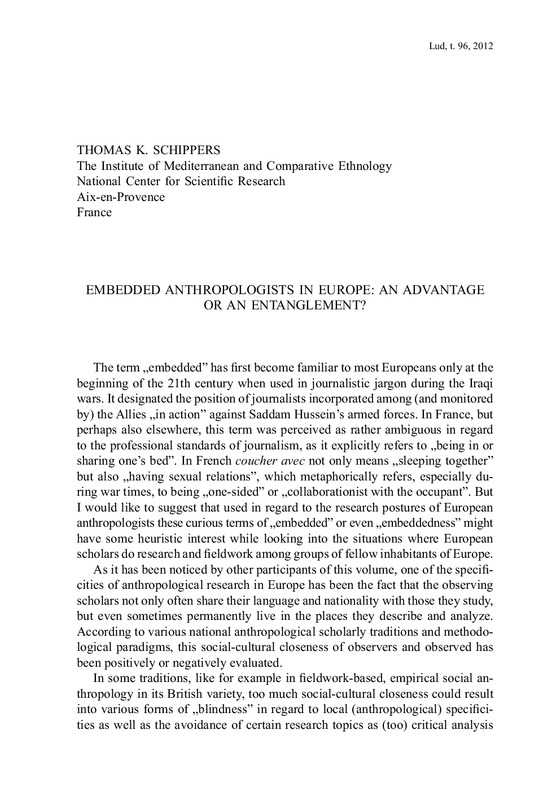
The term „embedded” has first become familiar to most Europeans only at the
beginning of the 21th century when used in journalistic jargon during the Iraqi
wars. It designated the position of journalists incorporated among (and monitored
by) the Allies „in action” against Saddam Hussein’s armed forces. In France, but
perhaps also elsewhere, this term was perceived as rather ambiguous in regard
to the professional standards of journalism, as it explicitly refers to „being in or
sharing one’s bed”. In French coucher avec not only means „sleeping together”
but also „having sexual relations”, which metaphorically refers, especially during war times, to being „one-sided” or „collaborationist with the occupant”. But
I would like to suggest that used in regard to the research postures of European
anthropologists these curious terms of „embedded” or even „embeddedness” might
have some heuristic interest while looking into the situations where European
scholars do research and fieldwork among groups of fellow inhabitants of Europe.
As it has been noticed by other participants of this volume, one of the specificities of anthropological research in Europe has been the fact that the observing
scholars not only often share their language and nationality with those they study,
but even sometimes permanently live in the places they describe and analyze.
According to various national anthropological scholarly traditions and methodological paradigms, this social-cultural closeness of observers and observed has
been positively or negatively evaluated.
In some traditions, like for example in fieldwork-based, empirical social anthropology in its British variety, too much social-cultural closeness could result
into various forms of „blindness” in regard to local (anthropological) specificities as well as the avoidance of certain research topics as (too) critical analysis
�136
Thomas K. Schippers
might endanger the observer’s position in his own society or group. According to
this type of heuristic paradigm, a certain degree of „otherness” and a correlated
awareness of it, are considered as basic prerequisites and necessary ingredients
to produce „valuable” data and analysis on items and topics that remain „hidden”
and unnoticed by the observed (including the local brands of researchers).
Strangely, a very similar type of arguments have been developed by those who
advocate the heuristic and qualitative superiority of the research results produced by those studying their own society or cultural group. Here the argument of
„a better understanding” of local practices, narratives and perceptions due to socio-cultural closeness is put forward. While in the United States according to this
type of standpoint being a woman, a black, a gay or a Muslim is sometimes considered to be an heuristic advantage to study respectively women, Afro-Americans,
gays or Muslims, in Europe similar argumentations have been advanced in regard
to various ethno-linguistic, regional and even national groups. I have personally
more than once heard that in order to produce valid data about Corsican culture,
one should at least be of some Corsican kin, while only a „real” Catalan (or Scot,
Basque, and so on) has the necessary legitimacy to write about Catalans (Scots or
Basques, and so forth).
It has been quite common in Europe that those following the Malinowskian
fieldwork paradigm based on „initial naivety/ignorance” and „learning from the
field” by clustering empirical observations and pigeon-holing them into local-knowledge-based concepts, have been accused of being unaware of or voluntarily ignoring autochtonous scholarship, not only in the scope of anthropology, but
also of history, demography, ethnology, statistics, and so on.
At least quite a number of anthropologists studying groups of Europeans
(or others) have positively considered the fact that the group they studied often
dislikes or even disapproves their writings. According to them, this shows they
have succeeded in revealing some „hidden dimensions” of local social relations
or cultural life. Here scholarly recognition in some academic circles is considered
as largely sufficient, while the disapproval by the groups studied even adds to the
quality to the scholar’s discernment and impartiality.
But for other Europeanists a recognition on behalf of the people they study
appears as important or even more valuable than some academic critique suggesting partiality or (ideological) one-sidedness. Here the more or less conscious
desire to be acknowledged and approved by one’s own group can lead to very
ambiguous situations especially when funding and/or political activism are at
stake. Even without getting into such extremes, I consider it as very important
to always acknowledge the various degrees of social, cultural but also financial
or logistic „embeddedness” of the researcher in regard to her or his fieldwork
situation. The time spend in the field is of course an important factor here. Data
and accounts produced after six or twelve months of fieldwork – not to speak of
the few weeks spent data-collecting by some so-called „multi-sited” researchers
�Embedded anthropologists in Europe: an advantage or an entanglement?
137
– are of course very different not only in quantity but also in quality from those
gathered by scholars who permanently „live” in or nearby their field of study. The
latter are often not only able to diachronically observe changes and do lengthy
local archive research, but also risk to become more and more „entangled” in
local social relations.
As a conclusion for this short note, one may remember what Tamas Hofer
once (1968) wrote about the „different [professional – T.K.S.] personalities” of
the various brands of anthropologists studying people in Europe. While social
and to a lesser degree cultural anthropologists do research in order to solve scholarly problems with the help of empiric „cases”, European ethnologists – often
academically trained in various disciplines ranging from history to dialectology – often collect data in a merely archivistic and/or museographic perspective.
Of course this classic opposition of nomothetic vs idiographic scholarly practices
and interests should today be mutually blended in order to build new, „grounded”
(rather than embedded) ways of practising an anthropology of Europeans rather
than of Europe.
REFERENCES
Hofer T.
1968
Anthropologists and Native Ethnographers in Central-European Villages: Comparative Notes on Professional Personalities of Two Disciplines,
„Current Anthropology” 9: 4, pp. 311-315.
�
-
Lud, t. 96, 2012
Embedded anthropologists in Europe: an advantage or an entanglement?
135
THOMAS K. SCHIPPERS
The Institute of Mediterranean and Comparative Ethnology
National Center for Scientific Research
Aix-en-Provence
France
EMBEDDED ANTHROPOLOGISTS IN EUROPE: AN ADVANTAGE
OR AN ENTANGLEMENT?
The term „embedded” has first become familiar to most Europeans only at the
beginning of the 21th century when used in journalistic jargon during the Iraqi
wars. It designated the position of journalists incorporated among (and monitored
by) the Allies „in action” against Saddam Hussein’s armed forces. In France, but
perhaps also elsewhere, this term was perceived as rather ambiguous in regard
to the professional standards of journalism, as it explicitly refers to „being in or
sharing one’s bed”. In French coucher avec not only means „sleeping together”
but also „having sexual relations”, which metaphorically refers, especially during war times, to being „one-sided” or „collaborationist with the occupant”. But
I would like to suggest that used in regard to the research postures of European
anthropologists these curious terms of „embedded” or even „embeddedness” might
have some heuristic interest while looking into the situations where European
scholars do research and fieldwork among groups of fellow inhabitants of Europe.
As it has been noticed by other participants of this volume, one of the specificities of anthropological research in Europe has been the fact that the observing
scholars not only often share their language and nationality with those they study,
but even sometimes permanently live in the places they describe and analyze.
According to various national anthropological scholarly traditions and methodological paradigms, this social-cultural closeness of observers and observed has
been positively or negatively evaluated.
In some traditions, like for example in fieldwork-based, empirical social anthropology in its British variety, too much social-cultural closeness could result
into various forms of „blindness” in regard to local (anthropological) specificities as well as the avoidance of certain research topics as (too) critical analysis
�136
Thomas K. Schippers
might endanger the observer’s position in his own society or group. According to
this type of heuristic paradigm, a certain degree of „otherness” and a correlated
awareness of it, are considered as basic prerequisites and necessary ingredients
to produce „valuable” data and analysis on items and topics that remain „hidden”
and unnoticed by the observed (including the local brands of researchers).
Strangely, a very similar type of arguments have been developed by those who
advocate the heuristic and qualitative superiority of the research results produced by those studying their own society or cultural group. Here the argument of
„a better understanding” of local practices, narratives and perceptions due to socio-cultural closeness is put forward. While in the United States according to this
type of standpoint being a woman, a black, a gay or a Muslim is sometimes considered to be an heuristic advantage to study respectively women, Afro-Americans,
gays or Muslims, in Europe similar argumentations have been advanced in regard
to various ethno-linguistic, regional and even national groups. I have personally
more than once heard that in order to produce valid data about Corsican culture,
one should at least be of some Corsican kin, while only a „real” Catalan (or Scot,
Basque, and so on) has the necessary legitimacy to write about Catalans (Scots or
Basques, and so forth).
It has been quite common in Europe that those following the Malinowskian
fieldwork paradigm based on „initial naivety/ignorance” and „learning from the
field” by clustering empirical observations and pigeon-holing them into local-knowledge-based concepts, have been accused of being unaware of or voluntarily ignoring autochtonous scholarship, not only in the scope of anthropology, but
also of history, demography, ethnology, statistics, and so on.
At least quite a number of anthropologists studying groups of Europeans
(or others) have positively considered the fact that the group they studied often
dislikes or even disapproves their writings. According to them, this shows they
have succeeded in revealing some „hidden dimensions” of local social relations
or cultural life. Here scholarly recognition in some academic circles is considered
as largely sufficient, while the disapproval by the groups studied even adds to the
quality to the scholar’s discernment and impartiality.
But for other Europeanists a recognition on behalf of the people they study
appears as important or even more valuable than some academic critique suggesting partiality or (ideological) one-sidedness. Here the more or less conscious
desire to be acknowledged and approved by one’s own group can lead to very
ambiguous situations especially when funding and/or political activism are at
stake. Even without getting into such extremes, I consider it as very important
to always acknowledge the various degrees of social, cultural but also financial
or logistic „embeddedness” of the researcher in regard to her or his fieldwork
situation. The time spend in the field is of course an important factor here. Data
and accounts produced after six or twelve months of fieldwork – not to speak of
the few weeks spent data-collecting by some so-called „multi-sited” researchers
�Embedded anthropologists in Europe: an advantage or an entanglement?
137
– are of course very different not only in quantity but also in quality from those
gathered by scholars who permanently „live” in or nearby their field of study. The
latter are often not only able to diachronically observe changes and do lengthy
local archive research, but also risk to become more and more „entangled” in
local social relations.
As a conclusion for this short note, one may remember what Tamas Hofer
once (1968) wrote about the „different [professional – T.K.S.] personalities” of
the various brands of anthropologists studying people in Europe. While social
and to a lesser degree cultural anthropologists do research in order to solve scholarly problems with the help of empiric „cases”, European ethnologists – often
academically trained in various disciplines ranging from history to dialectology – often collect data in a merely archivistic and/or museographic perspective.
Of course this classic opposition of nomothetic vs idiographic scholarly practices
and interests should today be mutually blended in order to build new, „grounded”
(rather than embedded) ways of practising an anthropology of Europeans rather
than of Europe.
REFERENCES
Hofer T.
1968
Anthropologists and Native Ethnographers in Central-European Villages: Comparative Notes on Professional Personalities of Two Disciplines,
„Current Anthropology” 9: 4, pp. 311-315.
�
-
Lud, t. 96, 2012
Embedded anthropologists in Europe: an advantage or an entanglement?
135
THOMAS K. SCHIPPERS
The Institute of Mediterranean and Comparative Ethnology
National Center for Scientific Research
Aix-en-Provence
France
EMBEDDED ANTHROPOLOGISTS IN EUROPE: AN ADVANTAGE
OR AN ENTANGLEMENT?
The term „embedded” has first become familiar to most Europeans only at the
beginning of the 21th century when used in journalistic jargon during the Iraqi
wars. It designated the position of journalists incorporated among (and monitored
by) the Allies „in action” against Saddam Hussein’s armed forces. In France, but
perhaps also elsewhere, this term was perceived as rather ambiguous in regard
to the professional standards of journalism, as it explicitly refers to „being in or
sharing one’s bed”. In French coucher avec not only means „sleeping together”
but also „having sexual relations”, which metaphorically refers, especially during war times, to being „one-sided” or „collaborationist with the occupant”. But
I would like to suggest that used in regard to the research postures of European
anthropologists these curious terms of „embedded” or even „embeddedness” might
have some heuristic interest while looking into the situations where European
scholars do research and fieldwork among groups of fellow inhabitants of Europe.
As it has been noticed by other participants of this volume, one of the specificities of anthropological research in Europe has been the fact that the observing
scholars not only often share their language and nationality with those they study,
but even sometimes permanently live in the places they describe and analyze.
According to various national anthropological scholarly traditions and methodological paradigms, this social-cultural closeness of observers and observed has
been positively or negatively evaluated.
In some traditions, like for example in fieldwork-based, empirical social anthropology in its British variety, too much social-cultural closeness could result
into various forms of „blindness” in regard to local (anthropological) specificities as well as the avoidance of certain research topics as (too) critical analysis
�136
Thomas K. Schippers
might endanger the observer’s position in his own society or group. According to
this type of heuristic paradigm, a certain degree of „otherness” and a correlated
awareness of it, are considered as basic prerequisites and necessary ingredients
to produce „valuable” data and analysis on items and topics that remain „hidden”
and unnoticed by the observed (including the local brands of researchers).
Strangely, a very similar type of arguments have been developed by those who
advocate the heuristic and qualitative superiority of the research results produced by those studying their own society or cultural group. Here the argument of
„a better understanding” of local practices, narratives and perceptions due to socio-cultural closeness is put forward. While in the United States according to this
type of standpoint being a woman, a black, a gay or a Muslim is sometimes considered to be an heuristic advantage to study respectively women, Afro-Americans,
gays or Muslims, in Europe similar argumentations have been advanced in regard
to various ethno-linguistic, regional and even national groups. I have personally
more than once heard that in order to produce valid data about Corsican culture,
one should at least be of some Corsican kin, while only a „real” Catalan (or Scot,
Basque, and so on) has the necessary legitimacy to write about Catalans (Scots or
Basques, and so forth).
It has been quite common in Europe that those following the Malinowskian
fieldwork paradigm based on „initial naivety/ignorance” and „learning from the
field” by clustering empirical observations and pigeon-holing them into local-knowledge-based concepts, have been accused of being unaware of or voluntarily ignoring autochtonous scholarship, not only in the scope of anthropology, but
also of history, demography, ethnology, statistics, and so on.
At least quite a number of anthropologists studying groups of Europeans
(or others) have positively considered the fact that the group they studied often
dislikes or even disapproves their writings. According to them, this shows they
have succeeded in revealing some „hidden dimensions” of local social relations
or cultural life. Here scholarly recognition in some academic circles is considered
as largely sufficient, while the disapproval by the groups studied even adds to the
quality to the scholar’s discernment and impartiality.
But for other Europeanists a recognition on behalf of the people they study
appears as important or even more valuable than some academic critique suggesting partiality or (ideological) one-sidedness. Here the more or less conscious
desire to be acknowledged and approved by one’s own group can lead to very
ambiguous situations especially when funding and/or political activism are at
stake. Even without getting into such extremes, I consider it as very important
to always acknowledge the various degrees of social, cultural but also financial
or logistic „embeddedness” of the researcher in regard to her or his fieldwork
situation. The time spend in the field is of course an important factor here. Data
and accounts produced after six or twelve months of fieldwork – not to speak of
the few weeks spent data-collecting by some so-called „multi-sited” researchers
�Embedded anthropologists in Europe: an advantage or an entanglement?
137
– are of course very different not only in quantity but also in quality from those
gathered by scholars who permanently „live” in or nearby their field of study. The
latter are often not only able to diachronically observe changes and do lengthy
local archive research, but also risk to become more and more „entangled” in
local social relations.
As a conclusion for this short note, one may remember what Tamas Hofer
once (1968) wrote about the „different [professional – T.K.S.] personalities” of
the various brands of anthropologists studying people in Europe. While social
and to a lesser degree cultural anthropologists do research in order to solve scholarly problems with the help of empiric „cases”, European ethnologists – often
academically trained in various disciplines ranging from history to dialectology – often collect data in a merely archivistic and/or museographic perspective.
Of course this classic opposition of nomothetic vs idiographic scholarly practices
and interests should today be mutually blended in order to build new, „grounded”
(rather than embedded) ways of practising an anthropology of Europeans rather
than of Europe.
REFERENCES
Hofer T.
1968
Anthropologists and Native Ethnographers in Central-European Villages: Comparative Notes on Professional Personalities of Two Disciplines,
„Current Anthropology” 9: 4, pp. 311-315.
�

 T.96_schippers.pdf