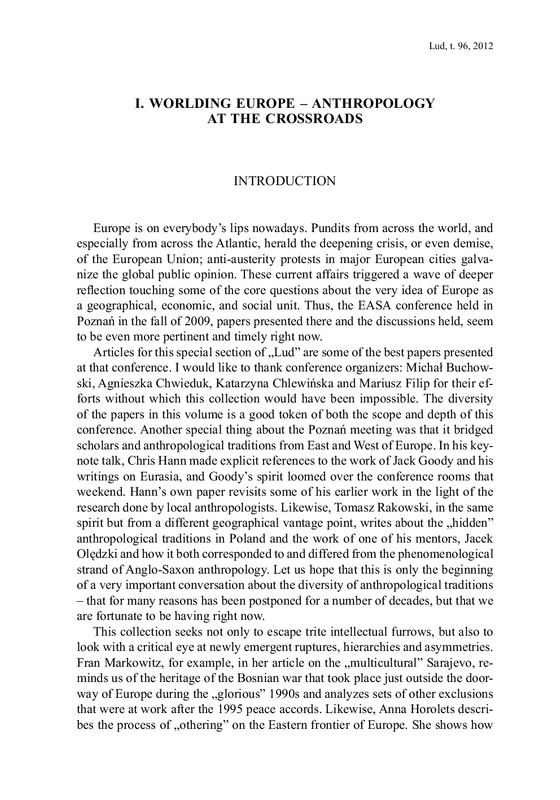
Introduction / Lud 2012, t. 96

Item

Title
Introduction / Lud 2012, t. 96
Description
Lud 2012, t. 96 : WORLDING EUROPE – ANTHROPOLOGY AT THE CROSSROADS
(edited by Kacper Pobłocki), s. 13-14
Creator
Pobłocki, Kacper
Date
2012
Subject
antropologia kulturowa
extracted text
Lud, t. 96, 2012

13

Krzysztof Pobłocki

I. WORLDING EUROPE – ANTHROPOLOGY
AT THE CROSSROADS

INTRODUCTION

Europe is on everybody’s lips nowadays. Pundits from across the world, and
especially from across the Atlantic, herald the deepening crisis, or even demise,
of the European Union; anti-austerity protests in major European cities galvanize the global public opinion. These current affairs triggered a wave of deeper
reflection touching some of the core questions about the very idea of Europe as
a geographical, economic, and social unit. Thus, the EASA conference held in
Poznań in the fall of 2009, papers presented there and the discussions held, seem
to be even more pertinent and timely right now.
Articles for this special section of „Lud” are some of the best papers presented
at that conference. I would like to thank conference organizers: Michał Buchowski, Agnieszka Chwieduk, Katarzyna Chlewińska and Mariusz Filip for their efforts without which this collection would have been impossible. The diversity
of the papers in this volume is a good token of both the scope and depth of this
conference. Another special thing about the Poznań meeting was that it bridged
scholars and anthropological traditions from East and West of Europe. In his keynote talk, Chris Hann made explicit references to the work of Jack Goody and his
writings on Eurasia, and Goody’s spirit loomed over the conference rooms that
weekend. Hann’s own paper revisits some of his earlier work in the light of the
research done by local anthropologists. Likewise, Tomasz Rakowski, in the same
spirit but from a different geographical vantage point, writes about the „hidden”
anthropological traditions in Poland and the work of one of his mentors, Jacek
Olędzki and how it both corresponded to and differed from the phenomenological
strand of Anglo-Saxon anthropology. Let us hope that this is only the beginning
of a very important conversation about the diversity of anthropological traditions
– that for many reasons has been postponed for a number of decades, but that we
are fortunate to be having right now.
This collection seeks not only to escape trite intellectual furrows, but also to
look with a critical eye at newly emergent ruptures, hierarchies and asymmetries.
Fran Markowitz, for example, in her article on the „multicultural” Sarajevo, reminds us of the heritage of the Bosnian war that took place just outside the doorway of Europe during the „glorious” 1990s and analyzes sets of other exclusions
that were at work after the 1995 peace accords. Likewise, Anna Horolets describes the process of „othering” on the Eastern frontier of Europe. She shows how

14

Introduction

Polish „niche tourists” seek risk-laden experiences in the former Soviet Union,
because by this they re-enact modernist model of risk-management, where human-related risk can be contained and mitigated. With an increasingly risk-prone
and powerless situation at home, the putatively „pristine” territories and peoples
of the rural post-Soviet countries serve as an existential and spiritual anchor in
uncertain times. The theme of globalization, and its impact on the people living
in Europe’s „backwater” (or, rather, on Europe’s icecap) is also scrutinized by
Kirsten Hastrup in her article. Finally, Maria de Fátima Amante analyzes in detail
the complicated process of „othering” during her fieldwork on the Spanish-Portuguese borderland, and shows how context-related subject positions can be.
Thus, the geographical scope of this collection is quite vast, and actually covers
the borders of „Europe” from each direction: from northern (Hastrup), through
western (Amante) and eastern (Horolets) to southern (Markowitz) fringes of
Europe. It is thus through looking at what is going on at Europe’s many frontiers
that we can redefine what constitutes the „core” of Europe and what is the place
of Europe in the larger world, as well as what are the quotidian sets of practices of „worlding” Europe. A set of methodological tools that can be very useful
for going about this is provided by Hastrup in the article opening this collection. This methodological reflection is later on continued in a number of papers.
Ewa Nowicka, Tomasz Rakowski and Maria de Fátima Amante ponder the vexed relationship between the subject and object in anthropological fieldwork, and
look at the limits of inter-human „involvement” of scholars in the lives of the
people and the social groups they study. Nowicka revisits a seemingly old case
of a „friendship” that developed between a Polish scholar Jerzy Ficowski and his
Roma informant and takes this as a departure point for a wider analysis of what
unexpected consequences can fieldwork bring and whether „friendship” is a virtue or a vice in anthropological toolbox.
As it is often the case, there are more questions than answers at hand – but
nobody can promise easy and quick solutions here. Although there is a very long
tradition of doing anthropology in Europe, the project of doing anthropology of
Europe is only in its incipient stage. Only recently did the West (Europe included)
cease being the sole „subject” of scholarly reflection, and the Rest is no longer
a passive „object”. Now the roles have been if not reversed, then at least made
much more complicated. This volume is clearly an example of that.
Kacper Pobłocki

Item sets
Lud 2

New Tags

I agree with terms of use and I accept to free my contribution under the licence CC BY-SA.